Coffee machines, water dispensers, bottle caps, and food processing lines all rely on silicone seals to keep liquids moving where they should. The hard part for buyers is not finding a seal that fits. It is proving that the material is safe for the food or water it touches, because the rules change by market and by application.
The short answer is that compliance depends on market and contact type, not on a universal “food grade” label. A silicone seal for food contact in the United States is typically specified to FDA 21 CFR 177.2600, while European buyers look to Regulation (EC) 1935/2004 and national measures such as Germany’s BfR Recommendation XV. Contact with drinking water requires a separate set of approvals, most often NSF/ANSI/CAN 61 in North America or WRAS in the United Kingdom. A food-contact certificate does not cover potable water contact, and the reverse is also true.
This article breaks down the materials behind compliant seals, the standards that apply by market, and the checks that keep a sourcing project on track. Working with an experienced Hersteller von maßgefertigten Silikondichtungen makes it easier to match both the compound and the paperwork to the application from the start.
What makes a silicone seal food-contact grade
A silicone seal counts as food-contact grade when its compound and documentation show that nothing harmful migrates into food or beverage under defined conditions of use. No single certificate makes a seal “food grade”; the evidence always ties back to a specific regulation and a specific set of temperatures, media, and contact times.
Silicone rubber has properties that map well onto food and water applications. The polymer backbone of silicon and oxygen stays stable at temperatures where most organic elastomers break down, and typical food-contact compounds remain flexible from about -40 °C to +230 °C. Silicone contains no plasticizers, absorbs little water, and is odorless and taste-neutral, so it does not transfer flavors into beverages. It also resists the repeated cleaning cycles that food equipment demands. Organic rubbers such as EPDM and natural rubber can handle some of these conditions, but they tend to absorb water, pick up odors, and degrade faster in hot, fatty, or acidic environments. That is why silicone has become the default elastomer for seals in coffee machines, beverage dispensers, baby feeding products, and water treatment hardware.
Two manufacturing choices matter as much as the base polymer. The first is the cure system. Platinum-cured silicone is the usual choice for food contact because it leaves fewer volatile by-products than peroxide-cured systems. The second is post-curing. A controlled oven cure after molding drives off low-molecular-weight siloxanes and other volatiles, which lowers extractables and reduces odor. Pigments and fillers must also be selected with compliance in mind, because an additive that is acceptable in an industrial seal can fail a migration test in a food application.
Food-contact standards by market
There is no single global food-contact standard for silicone, so the applicable rule depends on where the seal will be sold. A compound documented for one market is not automatically compliant in another, even when the base polymer is identical.
The table below summarizes the frameworks buyers encounter most often.
| Market | Framework | What it covers |
|---|---|---|
| United States | FDA 21 CFR 177.2600 | Rubber articles intended for repeated food contact, with extractable limits under conditions of use |
| European Union | Regulation (EC) 1935/2004 | Framework rule that materials must not transfer substances in quantities that endanger health or change food composition |
| European Union | Regulation (EC) 2023/2006 | Good manufacturing practice for food contact materials |
| Germany | BfR Recommendation XV | National recommendations for silicone in food contact, widely referenced across Europe |
| Germany / EU | LFGB | German food and feed law, including sensory testing for odor and taste transfer |
Under FDA 21 CFR 177.2600, silicone compounds are tested in food simulants such as water, alcohol, and acidic solutions at defined temperatures and contact times. The European path works differently: because the EU has no specific measure for silicone, compliance is demonstrated through the framework regulation, the GMP regulation, and national measures such as BfR XV. Buyers selling into both regions usually specify compounds that meet both sets of requirements at once.
Migration risk is not the same for every food. Fat, alcohol, and acidity all raise extraction, as do higher temperatures and longer contact times. A gasket that sits in a cold water line faces different conditions than a seal inside a hot beverage system, so the conditions of use belong in the specification alongside the standard itself.
Drinking-water standards for silicone seals
A seal that touches drinking water needs its own approval, because potable water regulations are separate from food-contact regulations. Passing one does not imply the other, and equipment makers often need both for the same machine.
The reference standard in North America is NSF/ANSI/CAN 61, which sets health-effect limits for contaminants that leach from products into drinking water. Sealing materials such as O-rings and gaskets fall under Section 6 of the standard, which covers joining and sealing materials. Certification is product-specific and formulation-specific, and NSF maintains a public listing of certified materials. You can review the scope of the standard on the NSF page for NSF/ANSI 61.
Other markets maintain their own schemes, and equipment sold internationally may need several of them.
| Scheme | Region | Focus |
|---|---|---|
| NSF/ANSI/CAN 61 | United States and Canada | Health effects of contaminants leaching into drinking water |
| WRAS (BS 6920) | United Kingdom | Effect of the material on water quality, including taste, odor, and support of microbial growth |
| KTW / UBA | Germany | German environment agency approval for materials in drinking water contact |
| DVGW W 270 | Germany | Resistance to microbial growth on materials in drinking water systems |
| ACS | France | French sanitary conformity attestation for water contact materials |
| AS/NZS 4020 | Australia and New Zealand | Testing of products for use in contact with drinking water |
In practice, these schemes touch a wide range of components: water line seals in coffee machines and espresso equipment, dispenser valves, filtration housings, faucet and shower components, and fittings in water treatment systems. A single machine exported to several countries can therefore need two or three approvals for the same part, sometimes molded from different compounds for different destinations.
Because each scheme runs its own tests in its own laboratories, a silicone seal approved in one market is not automatically acceptable in another. Confirm the destination markets before the compound is selected. Retesting a failed material costs far more than specifying the right one first, and a blocked shipment is more expensive still.
Certified versus compliant: mistakes that cost buyers
The most common mistake is assuming that a food-contact certificate also covers drinking water, and the second is accepting a compliance claim without checking who actually tested the material. Both errors surface late, usually at a customer audit or a port inspection, when they are most expensive to fix.
“Food grade” and “drinking water safe” are two different risk models. Food-contact rules ask what transfers into food under eating and drinking conditions. Drinking-water schemes ask what leaches into water that people consume daily over years, with strict limits on specific metals and organic compounds. A compound can pass FDA 21 CFR 177.2600 and still fail NSF/ANSI 61, so a seal destined for a water dispenser or a coffee machine water line needs both paths confirmed.
Labels also need scrutiny. NSF does not use the term “approved.” A material described as NSF certified has been independently tested and appears in NSF’s public listings, while a material described only as NSF compliant has been evaluated by the manufacturer alone. The same distinction applies to FDA claims: compliant means the manufacturer holds the supporting evidence, and approved is not a formal FDA designation for rubber articles.
A third mistake is ignoring changes after certification. Compliance follows the formulation, so switching the cure system, the pigment, or even a single additive can invalidate existing test reports. Buyers should ask whether the certificate on file matches the compound actually being molded, and request written notification for any formulation change.
Types of silicone seals for food and water applications
Compliant silicone compounds are formed into several seal types, and each type solves a different assembly problem. Knowing the vocabulary helps buyers request the right part rather than a generic “seal.”
Silicone seal rings and gaskets
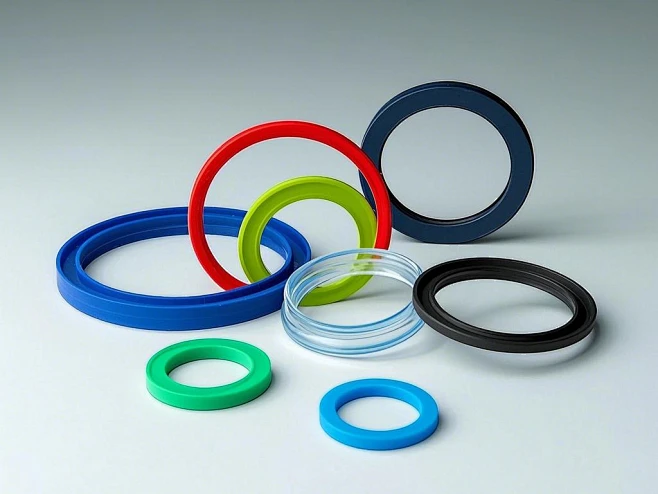
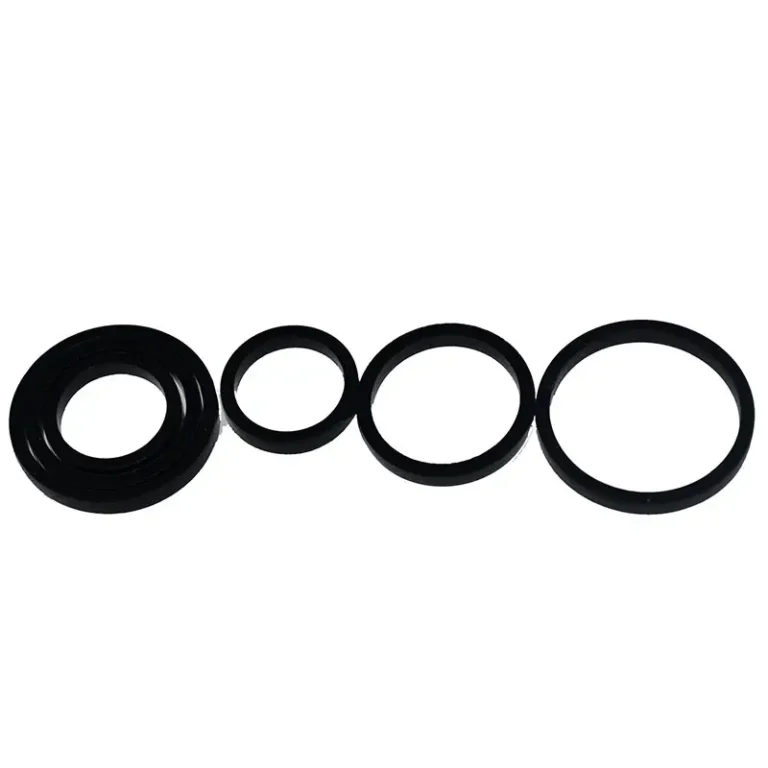
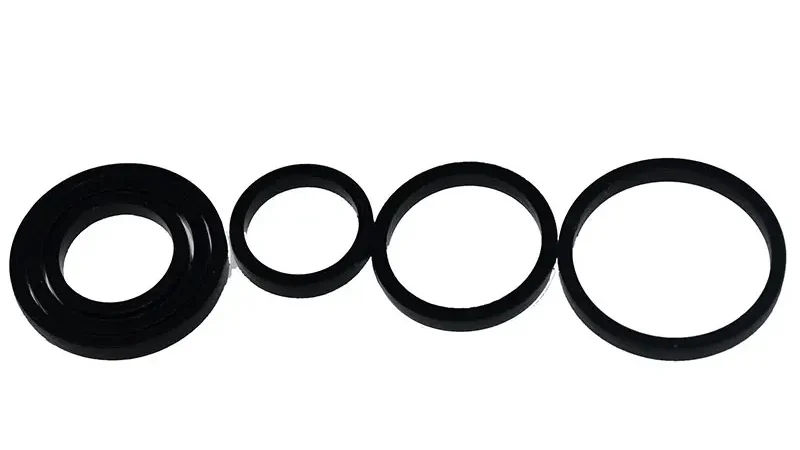
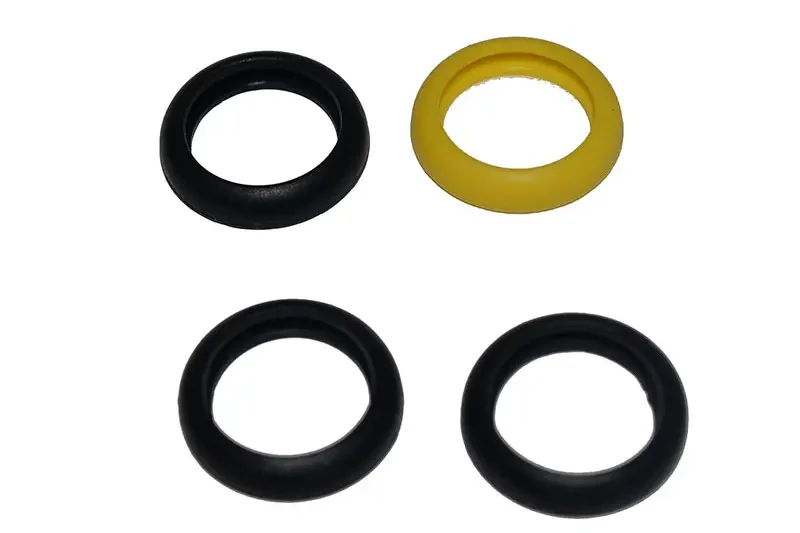
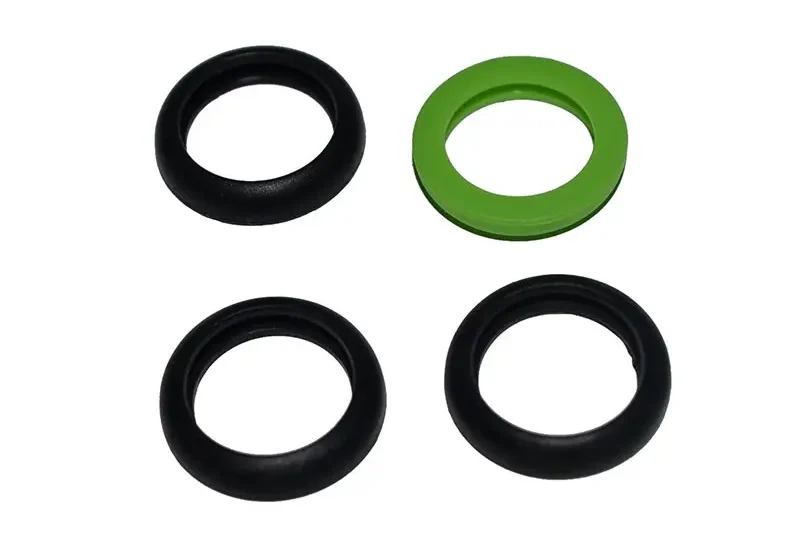
A silicone seal ring is the usual choice for sealing on spouts, valves, and lids, while a silicone seal gasket sits in a recess and seals a flat joint such as a bottle cap or a container lid. Both are commonly molded in food-contact grades for beverage equipment, water bottles, and food storage products. A typical example is this silicone sealing ring designed for a moka coffee pot, where the seal must handle steam pressure, heat, and repeated brewing cycles without transferring taste. Rings and gaskets can be molded in standard or custom sizes, and liquid silicone rubber (LSR) molding gives tight tolerances for small, high-volume parts.
Silicone seal strips
A silicone seal strip is an extruded profile used where a long, continuous seal is needed: oven doors, food display cabinets, processing equipment enclosures, and doors on cleanroom-style food production areas. Strips specified in food-contact grades are chosen for their temperature range, low odor, and easy cleaning, and they can be cut or joined to length on site.
Silikon-Dichtungsband
A silicone seal tape is a self-fusing tape wrapped over joints, threads, and small gaps. In food and beverage settings it serves as a maintenance tool for temporary repairs and for sealing threaded connections on utility lines. Tape does not replace an engineered seal: any permanent joint in the product path should use a molded or extruded part made from a documented, compliant compound.
How to specify a compliant silicone seal
A clear specification is what turns a general compliance claim into a deliverable, because every test report is valid only for a defined set of conditions. The more precisely the application is described, the less chance there is of a mismatch between the certificate and the part.
Before requesting a quotation, work through this list:
- Destination markets, so the compound is selected against FDA, EU, NSF, WRAS, or other requirements from the start.
- Contact type, meaning food, beverage, drinking water, or only incidental splash.
- Media, including water, fats, alcohol, or acidic products, since each raises different migration risks.
- Continuous and peak temperatures, plus any steam or sterilization cycles.
- Contact time, and whether exposure is short, long, or repeated.
- Cleaning chemicals and concentrations, especially the alkaline cleaners used in food plants.
- Mechanical requirements such as hardness, compression set, and whether the seal is static or moving.
- Documentation needed, including test reports, formulation change notification, and certificates of conformity.
Suppliers who ask these questions before quoting usually produce seals that pass certification on the first attempt. Suppliers who skip them tend to discover the missing requirement during a customs check or a customer audit. Either way, the answers belong in the purchase order rather than in an email thread after a failed test. If you are preparing a specification now, sending the list above with your drawing is the fastest way to get an accurate quotation and a material that is right the first time.
Häufig gestellte Fragen
What temperature range can food-contact silicone seals handle?
Most food-contact silicone compounds remain flexible from about -40 °C to +230 °C, which covers freezing, boiling, baking, and steam exposure. The exact ceiling depends on the compound, so confirm the rating for continuous operation rather than only for peak temperature.
Do food-contact or drinking-water certificates expire?
The reports themselves do not carry a fixed expiration date, but they are valid only for the tested formulation and the revision of the standard used. Retesting is required when the formulation, cure system, or pigments change, and some customers ask for updated reports on an annual cycle.
Does food-grade silicone contain BPA or release microplastics?
Food-contact silicone is not a plastic and contains no BPA, which is an additive associated with polycarbonate plastics. Silicone is a synthetic elastomer built on a silicon and oxygen backbone, and it does not shed microplastic particles the way polyethylene or polypropylene products can.