Vehicles are assembled from thousands of joints that must stay sealed across a temperature span of more than 300 °C, under continuous vibration, and in contact with road salt, ultraviolet light, oil and fuel. Sealing failures remain one of the most common causes of warranty claims, and many trace back to a specification that was inherited rather than defined. Silicone rubber has become one of the most widely specified elastomers for these joints, not because it is the cheapest rubber available, but because its performance window covers conditions that defeat most alternatives.
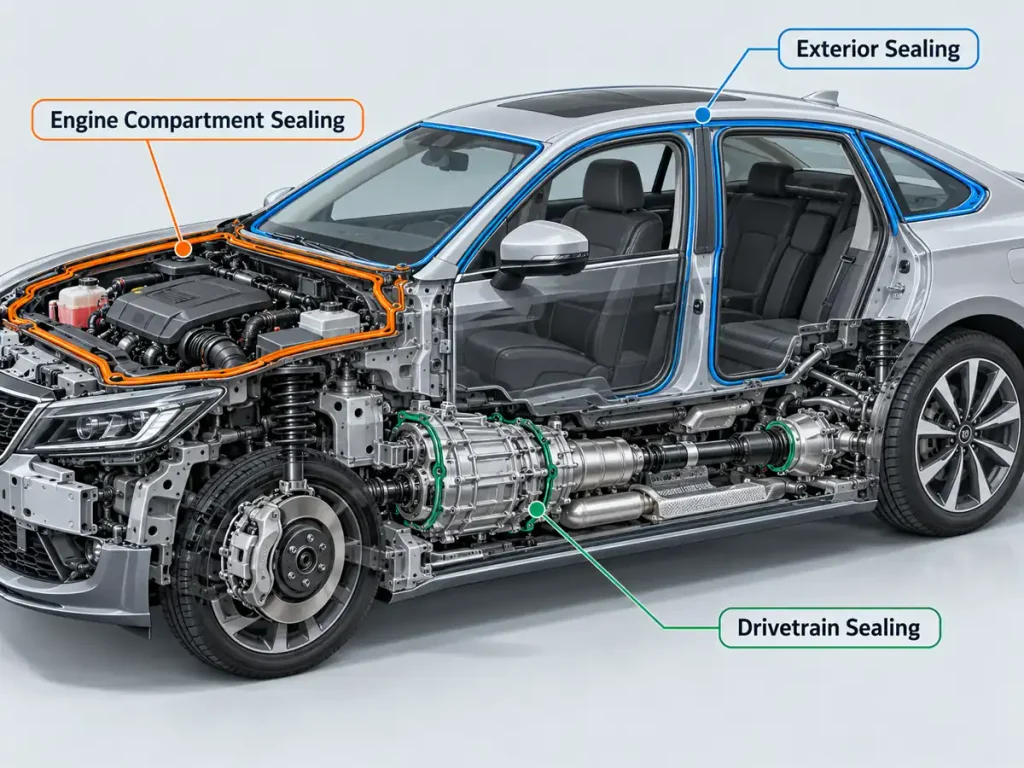
Automotive silicone seals are elastomeric sealing components moulded or extruded from silicone rubber, also designated VMQ, and they are specified across three vehicle zones: exterior sealing against weather, water and ultraviolet exposure; engine compartment sealing against heat, thermal cycling and fluid contact; and drivetrain sealing in transmissions, axles and electric drive units. Silicone is chosen where the temperature range, weather resistance or dielectric behaviour of other rubbers is not enough, and a silicone seal manufacturer produces these parts as moulded seals, extruded profiles, O-rings, gaskets, sealants and overmoulded assemblies.
The three zones ask different things of the same base polymer.
What Are Automotive Silicone Seals?
Automotive silicone seals are sealing components made from silicone rubber, a synthetic elastomer built on a silicon-oxygen backbone rather than the carbon-carbon backbone of most other rubbers. That backbone produces the property set engineers rely on: flexibility from roughly -60 °C to 250 °C, resistance to ozone and ultraviolet degradation, predictable compression recovery, and high dielectric strength. The parts take several forms, including moulded seals, extruded strips and profiles, O-rings, flat gaskets, room temperature vulcanising sealants and overmoulded assemblies.
Silicone sits at the top of the temperature range and near the top of weather resistance, while giving ground on mechanical strength and fluid resistance. That trade-off belongs in the specification, not in the purchase order.
Silicone vs Other Automotive Elastomers
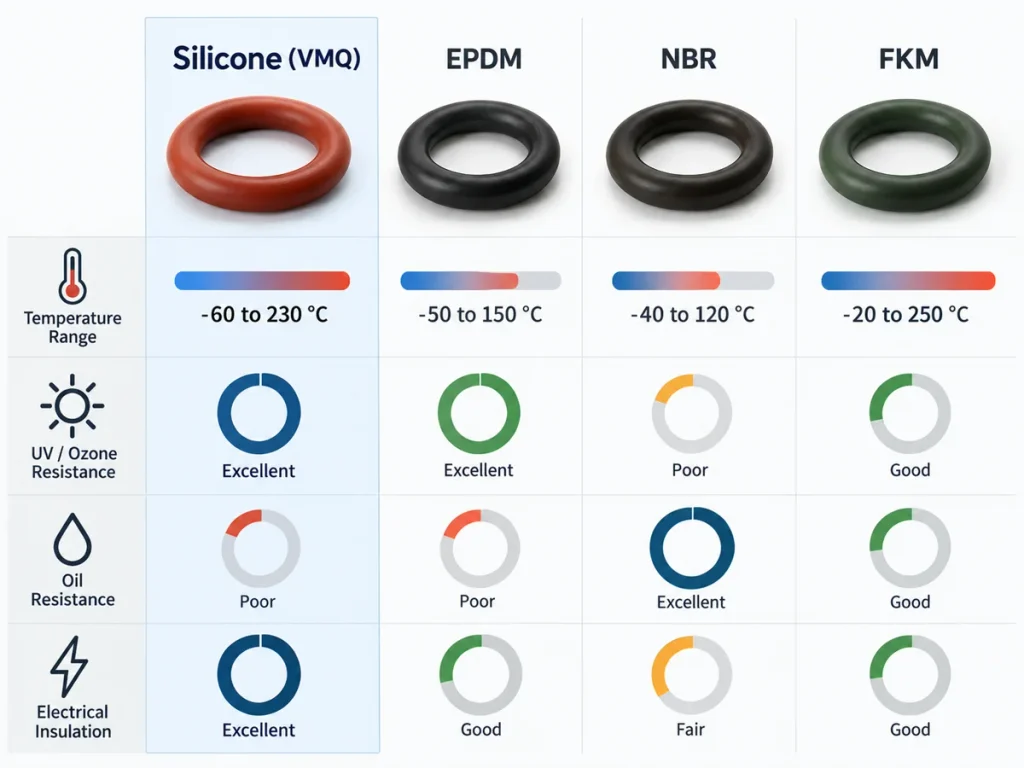
Four elastomers account for most automotive sealing specifications, and they are not interchangeable.
| Property | Silicone (VMQ) | EPDM | NBR | FKM |
| Service temperature range | -60 to 250 °C | -50 to 150 °C | -30 to 100 °C | -20 to 200 °C |
| Weather, ozone and UV resistance | Excellent | Excellent | Poor | Good |
| Engine oil and fuel resistance | Fair | Poor | Excellent | Excellent |
| Dielectric strength | Excellent | Good | Fair | Good |
| Tensile and tear strength | Low to moderate | High | High | Moderate |
| Relative material cost | High | Low | Low | Very high |
| Typical use on a vehicle | Exterior and hot engine seals | Door and window weatherstrips | Fuel and oil system seals | Fuel system and hot oil seals |
The honest reading is that silicone wins on temperature, weather and electrical insulation, and loses on oil and fuel immersion. Continuous contact with hot hydrocarbon fluids is normally assigned to NBR, HNBR or FKM, while silicone takes the joints where heat, sunlight, ozone or voltage stress is the governing load case. A specification that ignores this split usually shows up later as a swollen seal.
What Automotive Silicone Is Used For
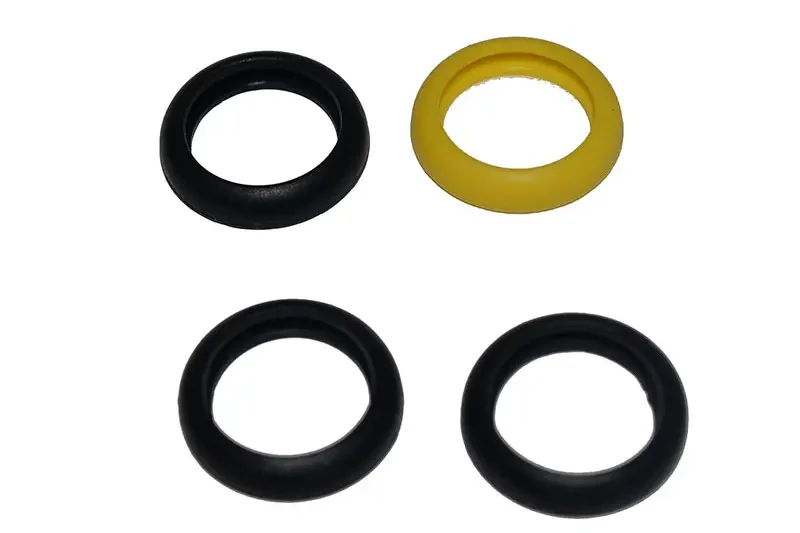
The answer is broader than gaskets. Silicone rubber seals appear as:
Why Silicone Is Specified in Vehicles
The silicon-oxygen backbone is more thermally stable than a carbon backbone, which creates the wide service window. Four advantages follow: low temperature flexibility that stops the seal taking a permanent set in a cold climate, ozone and ultraviolet stability so exterior parts do not crack or chalk, compression set recovery that lets a seal squeezed for a decade still push back against its mating surface, and dielectric strength that allows the same material to insulate as well as seal.
Exterior Silicone Seals: Weather, Water and UV Protection
Exterior silicone seals protect joints that face rain, snow, road spray, ozone and direct sunlight for the whole service life of the vehicle, and their main failure mode is environmental ageing rather than mechanical wear. Silicone resists that ageing better than any other standard elastomer, which is why it is specified where cracking, hardening or colour change would create a visible leak or an appearance defect.
Where Exterior Seals Sit on a Vehicle
| Exterior location | Typical seal form | Reason silicone is specified |
| Windshield perimeter and wiper blade | Extruded profile, moulded blade | UV and ozone exposure, temperature swing |
| Door and window openings | Extruded hollow profile | Compression recovery over opening cycles |
| Luggage compartment and tailgate | Extruded strip, moulded corners | Water ingress resistance at corner joints |
| Lamp and sensor housings | Moulded gasket, grommet | Sealing plus dielectric insulation |
| Charging port and high voltage covers | Moulded seal | Dielectric requirements plus weathering |
Wipers illustrate the exterior case well, because the part is at once a weather seal and a moving contact element. Silicone car windshield wiper blades rely on the same low temperature flexibility and ozone resistance that keeps a static profile sealed.
Why Silicone Outperforms Other Rubbers Outdoors
EPDM is the highest volume exterior weatherstrip material in the industry, and it earns that position on cost and adequate weathering. Three conditions push the decision to silicone: a temperature range beyond what EPDM can hold, a colour requirement that rules out carbon black compounds, and joints where one part must seal and insulate at once. Because silicone does not rely on a carbon black filler for UV stability, light coloured and translucent seals also stay stable.
Water Ingress and Connector Sealing
Exterior electrical joints are usually the weakest point in a water ingress strategy. A connector that reseals at its housing but not around its conductors still admits moisture along the cable. Silicone wire seals, grommets and boots close that path and insulate the circuit at the same time.
Engine Compartment Silicone Seals: Heat, Oil and Fluid Resistance
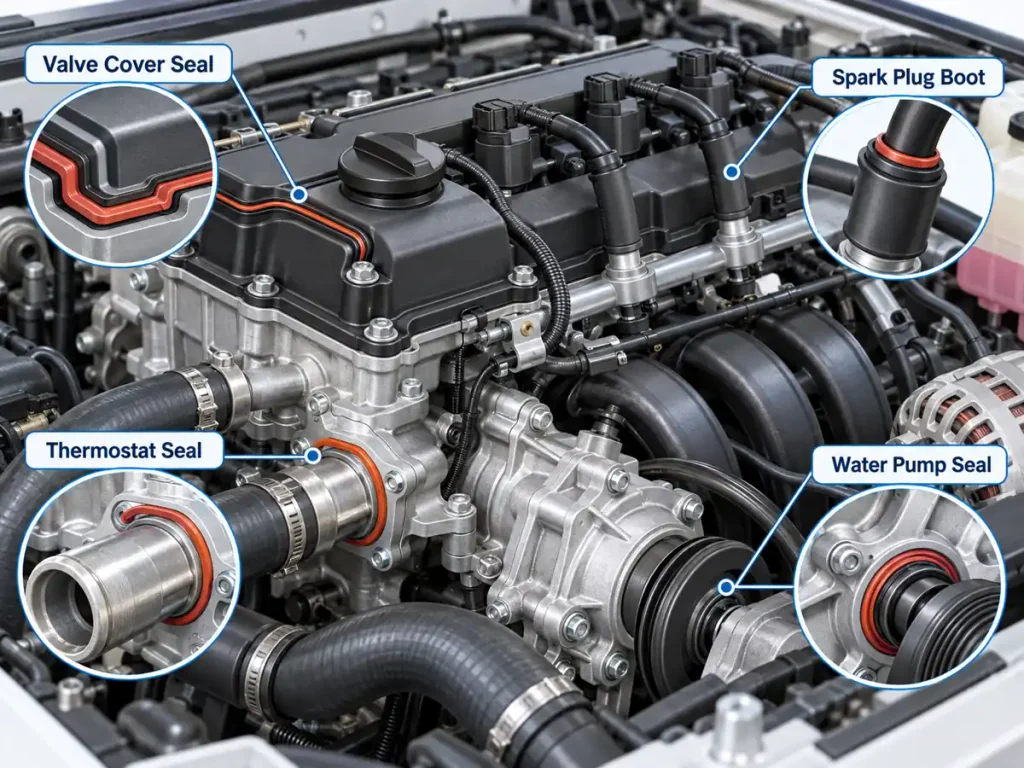
Engine compartment silicone seals manage the most demanding combination of loads on the vehicle: radiant and conducted heat, rapid thermal cycling, vibration, and exposure to oil, coolant and blow-by gases. The temperature range and compression recovery of silicone suit these joints, but fluid contact is where selection becomes conditional, because resistance to hot hydrocarbon fluids is only moderate.
High-Temperature Zones and Where Seals Fail
Underhood temperatures vary by an order of magnitude across the compartment.
| Zone | Approximate exposure | Sealing implication |
| Valve cover and cylinder head | Sustained high heat | Oil resistance with thermal stability |
| Oil pan and timing cover | Cycling with oil contact | Compression set recovery under bolt load |
| Thermostat housing and water pump | Coolant contact and cycling | Coolant and temperature resistance combined |
| Turbocharger and charge air plumbing | Highest peak temperatures | Requires a high temperature grade |
| Spark plug and ignition boots | Heat plus voltage | Dielectric strength beside heat resistance |
Seals here rarely fail from one cause: heat ages the compound, compression set reduces the sealing force, and vibration then opens a path that was previously marginal.
Silicone Sealants and RTV vs Pre-Cut Gaskets
The question of which sealant is best for an engine has no single answer, because a silicone gasket for automotive applications has to follow the joint design rather than the product category. Formed in place gaskets made from room temperature vulcanising silicone are the factory specification on many modern joints, while others must use a pre-cut gasket.
Use a formed in place silicone gasket where the manufacturer specifies one, typically:
- Oil pans and oil pan covers on cast surfaces
- Valve covers with straight, undamaged sealing faces
- Timing covers and water pump housings
- Thermostat housings and similar small, simple sealing faces
Use a pre-cut or multi-layer gasket, without substituting sealant, on:
- Cylinder head joints, which must withstand combustion pressure
- Exhaust manifold joints, which see combustion gas temperature
- Intake manifold joints, which seal vacuum, coolant and air passages at once
Two constraints follow. Silicone sealant on a joint connected to the crankcase ventilation system must be a neutral cure, sensor safe grade, because vapour from an acid cure formulation can migrate to the oxygen sensor and degrade it. A formed in place joint also needs close to 24 hours at room temperature to cure. Seal geometry, hardness and compound choice are covered in the silicone seal specification guide.
Fluid Compatibility Limits of Silicone in the Engine Bay
This is where silicone is often oversold. Silicone rubber performs at a fair level against engine oil and swells noticeably in some hydrocarbon fluids and aromatic solvents. Where a seal is immersed in hot oil or fuel as its governing condition, NBR, HNBR or FKM are the more appropriate materials. Silicone earns its place in the engine bay through heat resistance, weather stability, compression recovery and dielectric strength, and it suits a joint that runs hot and dry better than one that sits in oil.
Drivetrain Silicone Seals: Transmission, Axle and Electric Drive
Drivetrain silicone seals close joints in transmissions, differentials, transfer cases and electric drive units, where the priorities are dynamic sealing, vibration tolerance and a service life that matches the assembly. Silicone contributes vibration damping and thermal stability here, but seal geometry and joint design carry at least as much responsibility for the result as the compound.
Transmission and Differential Sealing
Drivetrain housings combine machined flanges, rotating shafts and electronic actuators in one assembly, and each needs a different seal type.
| Joint type | Seal approach | Working principle |
| Machined housing flange | Formed in place gasket | Flexible film fills surface irregularities under bolt load |
| Rotating shaft | O-ring or sealing ring | Radial interference holds contact as the shaft turns |
| Actuator and solenoid interface | Moulded seal, grommet | Static sealing with vibration isolation |
| Speed and position sensor port | Moulded seal plus wire seal | Sealing and electrical insulation in one interface |
Sensor and actuator ports in a modern transmission carry conductors through the housing wall, so the seal has to manage fluid containment and electrical isolation together. Automobile silicone wire seals exist for that overlap, sealing around individual conductors while insulating the circuit from the housing.
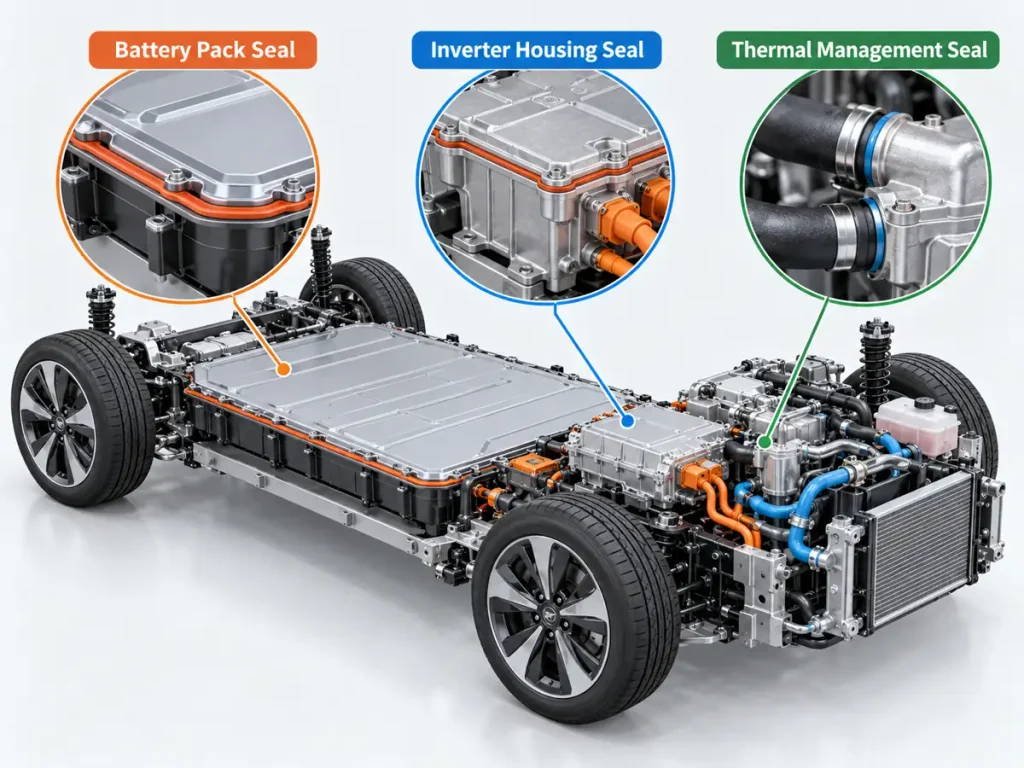
Seals in Electric Vehicle Drivetrains
Electric drive units change the load case rather than reducing it. Battery pack covers need long term sealing against water and dust ingress. Inverters and power electronics need enclosure sealing and dielectric insulation at the same time. Thermal management circuits need seals that tolerate repeated heating and cooling without losing compression. The wide service window and dielectric strength of silicone suit all three.
Vibration, Misalignment and Service Life
A drivetrain seal is rarely asked to hold a perfect geometry. Housings flex, shafts move, and operating temperatures change clearances. Silicone stays elastic across that range and absorbs vibration energy rather than transmitting it, which extends seal life in ways a hardness number alone does not predict.
Silicone vs Rubber Gaskets: Which Is Better for Your Application?
Neither material is universally better, and the question needs correcting first: silicone is a rubber, so the practical comparison is silicone against other rubber compounds such as EPDM, NBR and FKM. The answer follows three variables, which are the maximum and minimum service temperature, the fluids the seal will contact, and whether the joint is static or moving. Match those three, and the shortlist usually falls to two materials.
| Application condition | Recommended elastomer | Reason |
| High temperature, dry contact | Silicone | Widest temperature range with no oil immersion |
| Outdoor weather exposure, high volume | EPDM | Adequate weathering at lower material cost |
| Continuous hot oil immersion | NBR or HNBR | Oil resistance is the governing requirement |
| Sealing plus electrical insulation | Silicone | Highest dielectric strength of standard elastomers |
| Cold climate exterior joint | Silicone | Flexibility maintained at low temperature |
ASTM D2000 and its SAE equivalent classify rubber compounds by heat resistance and fluid resistance class, so a supplier can be given one line of specification rather than a description. See the ASTM D2000 standard for the classification basis and the SAE J200 standard for the automotive equivalent.
Specifying and Qualifying Automotive Silicone Seals
Most sealing failures originate in the specification rather than the material, because a compound that is technically suitable will still fail if hardness, temperature class, cure system or tolerance is left undefined. A complete specification states the operating window, the fluid contact, the required compression set, and the dimensional tolerances the part will be held to, and it is the document an automotive silicone seal manufacturer should be asked to work from.
Specification Parameters That Matter
Six parameters carry most of the risk:
- Service temperature range, stated as continuous and short term peak values
- Hardness in Shore A, usually 30 to 80, chosen against the compression the joint can apply
- Compression set after a defined time and temperature, which predicts sealing force retention
- Tensile and tear strength, which matter where the seal is stretched or has thin edges
- Cure system, which decides whether the part is sensor safe and how it behaves against the substrate
- Dimensional tolerances and flash allowance, since a dimensionally inconsistent seal will leak intermittently
Testing, Standards and Documentation
Qualification combines compound testing and part testing. Compound testing covers thermal ageing, fluid immersion and compression set. Part testing covers dimensional inspection and sealing performance under the specified pressure or water ingress condition. Buyers should expect a compound designation, material certificates and batch traceability, which is why silicone manufacturing certifications are a practical screening question rather than a formality.
Custom Automotive Silicone Seal Solutions
A sealing catalogue is only useful if the parts can be produced to the drawing, so the practical question for a buyer is not which material wins on paper but which automotive silicone seal manufacturer can hold the specification in volume. Custom development covers compound selection, tooling, moulding or extrusion, secondary operations and validation against the agreed test plan.
An automotive silicone seal manufacturer normally supports this scope:
- Custom moulding and silicone extrusion profiles built to drawing
- Compound selection validated against the application fluid and temperature window
- Automotive O-rings, gaskets and sealing rings across hardness and tolerance grades
- Silicone wire seals, boots and grommets for connector and sensor interfaces
- Secondary operations such as deflashing, bonding and overmoulding onto metal
- OEM and ODM programmes from concept through to mass production
Compound selection is usually settled during prototyping, when hardness, compression set and cure system can be tested against the real joint rather than a datasheet. Parts that are tolerance-led benefit from a precision silicone part manufacturer, while concept-to-production programmes run under ODM OEM silicone LSR solutions.
FAQ
What durometer is recommended for automotive silicone seals?
Most are specified between 40 and 70 on the Shore A scale. Softer compounds in the 30 to 50 range suit low compression force joints and conformable exterior profiles, while 60 to 80 suits static joints under higher bolt load. The governing number is not a preference but the compression the joint geometry can sustain.
Do automotive silicone seals resist fuel and engine oil?
They tolerate incidental contact but are not the right choice for continuous immersion. Silicone swells in many hydrocarbon fluids, and its oil resistance is moderate compared with NBR, HNBR or FKM. Where a seal sits in fuel or hot oil as its normal condition, one of those compounds should be specified instead.
At what low temperature do automotive silicone seals stop working?
Standard compounds remain flexible down to about -60 °C, below the range of any normal vehicle operating environment. Low temperature performance is limited by stiffening rather than cracking, and the practical risk in cold climates is compression set after long periods under load, not loss of flexibility during operation.
What is the difference between silicone seals and rubber seals?
Silicone is itself a rubber, so the difference is one of chemistry rather than category. Silicone uses a silicon-oxygen backbone, while EPDM, NBR and FKM use carbon backbones with different side groups. That single difference explains the ranking: silicone holds the widest temperature range and the best weather and dielectric performance, while carbon-backbone rubbers generally win on oil resistance and mechanical strength.
Are silicone seals suitable for electric vehicles?
They suit the joints that define an electric vehicle, in particular battery pack and enclosure sealing, inverter and power electronics housings, and thermal management circuits. Dielectric strength, thermal stability and low temperature flexibility all match the requirement. The usual caveat still applies: where a seal sits in contact with coolant or oil as its normal condition, the compound has to be selected against that fluid rather than assumed to work.