A silicone seal rarely fails because someone picked the wrong polymer family. It fails because the drawing said “soft” instead of 50 Shore A, because the tolerance was copied from a machined part and no molder could ever hold it, or because the material grade was chosen for temperature when the real exposure was oil. Each of those gaps costs a tooling cycle, a sample round, or a rejected lot, and each of them is preventable at the specification stage.
A working specification for a custom silicone seal needs four lines: the seal form, the material grade and its cure system, the target hardness in Shore A with a tolerance, and the dimensional tolerance class taken from ISO 3302-1. Color, packaging, and paperwork come later, because they can be changed without touching the mold.
Suppliers who build these parts to a drawing, such as a custom silicone seal manufacturer working from 2D and 3D files, will ask for those four lines before they quote anything. The order matters, since each decision narrows the next one.
What counts as a custom silicone seal
Anything molded, extruded, or die-cut to a drawing instead of picked from a catalog is a custom silicone seal, and the three form families behave very differently on a print and in a purchase order. Form is the first decision because it decides which processes are available and which tolerance class is realistic.
Seal strips and tapes
A silicone seal strip is an extruded profile that runs in continuous lengths. Common cross-sections include bulb, P, D, U-channel, and simple rectangular cord. The profile is extruded, then cut to length or vulcanized into a closed loop where a continuous seal is required around a door, cover, or cabinet frame. Extruded profiles carry their own tolerance class in ISO 3302-1, separate from the molded classes, because die swell and take-off tension make extrusion looser than molding on the same drawing.
A silicone seal tape is usually a flat strip with an adhesive backing, die-cut or slit from a calendered sheet rather than extruded. Tapes are the right answer for enclosure sealing, gasket replacement on flat faces, and low-volume work where a die costs less than a mold. If the joint is three-dimensional, or if the seal has to hold a compression load, tape is the wrong starting point.
Rings and gaskets
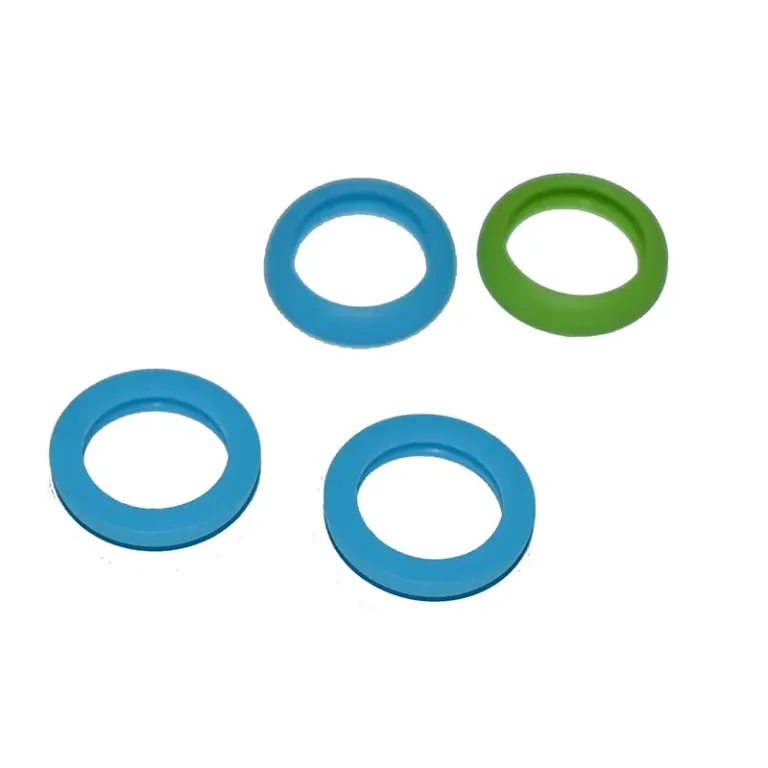
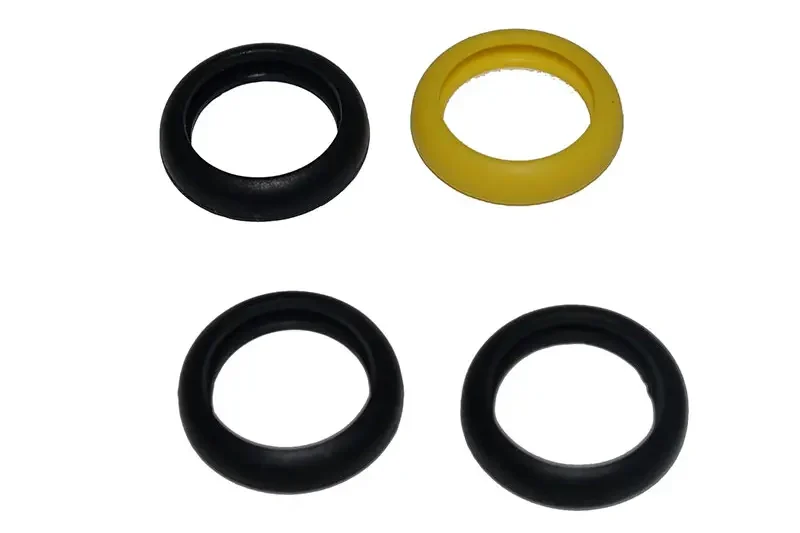
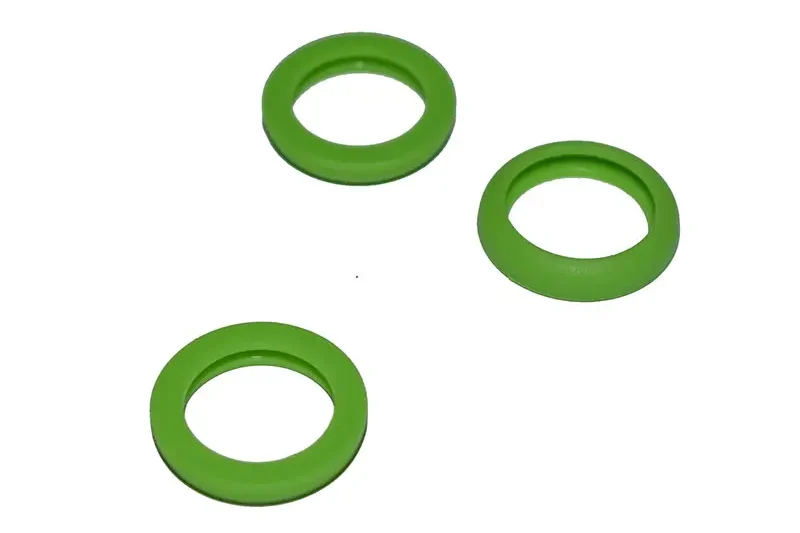
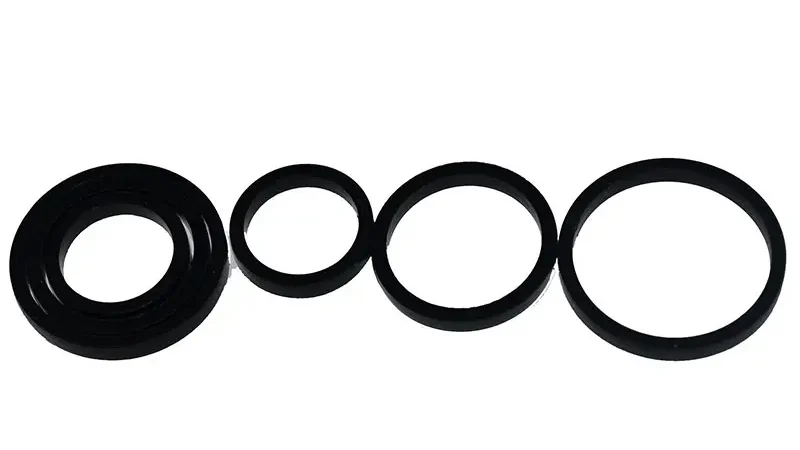
A silicone seal ring is a closed loop, most often an O-ring or a quad-ring molded to a standard size series such as AS568 or ISO 3601, or to a custom cross-section when the gland is non-standard. A molded silicone rubber O-ring is the usual starting point for a circular gland, because a standard cross-section can often be tooled from an existing mold. A silicone seal gasket is a face seal: a flange gasket, a lid seal, or a housing gasket that may be molded, die-cut from sheet, or a molded gasket with bosses and alignment features.
The practical split is simple. If the geometry is a closed loop or has any three-dimensional feature, it is molded, because nothing else can produce that shape. If it is flat and two-dimensional, die-cutting skips mold tooling altogether and is usually the fastest route from drawing to sample.
Overmolded and bonded seals
Seals are frequently molded directly onto a plastic or metal substrate so the part arrives at the assembly line as one component. Common combinations include liquid silicone rubber bonded to a rigid plastic body and silicone bonded to a stamped or machined metal insert. Overmolding removes a manual assembly step and eliminates the tolerance stack between a separate seal and its housing, which matters most when the seal is small. It also raises tooling complexity, so it usually pays off only when the volume and the assembly saving justify it.
| Seal form | Typical process | Best sealing duty | Realistic tolerance class |
|---|---|---|---|
| Extruded strip or profile | Extrusion, corner vulcanizing | Door, cover, and frame seals in long lengths | Extruded class per ISO 3302-1 |
| Adhesive-backed tape | Die-cutting from sheet | Flat faces, enclosures, low volume | M3 as a practical default |
| O-ring or quad-ring | Compression molding, LSR injection | Static and dynamic circular glands | M2 for precision, M3 standard |
| Flange or lid gasket | Compression molding, die-cutting | Face sealing under bolt load | M2, where the fit is critical |
| Overmolded seal | LSR injection, insert molding | Sealed plastic or metal assemblies | M1 to M2 |
Silicone grades: matching material to contact and exposure
Grade selection comes down to two questions: what the seal touches and what the cure system has to leave behind in the finished part. Temperature and hardness range across grades, but the differences that cause real project failures are contact compliance and extractables.
General-purpose and high-temperature silicone
General-purpose silicone covers enclosures, industrial equipment, appliance gaskets, and protective covers. It offers a wide service band with good retention of flexibility at low temperature and good aging resistance at high temperature. High-temperature grades are formulated for equipment that runs hot, including heating appliances, exhaust-adjacent parts, and industrial machinery, and they trade some mechanical strength for thermal stability.
Two caveats apply to any temperature claim. First, the rated range is a property of the specific compound, not of silicone in general, so the supplier’s data sheet governs. Second, hardness moves with temperature in service: a seal specified at 50 Shore A reads firmer when cold and softer when hot. Where a seal runs at the edge of its thermal range, the drawing should state the working temperature so the supplier can judge the effective hardness at that condition rather than at room temperature.
Food-contact grades
Food-contact silicone has to clear extraction limits, not just be chemically inert. In the United States, the reference is FDA 21 CFR 177.2600 for rubber articles intended for repeated use, which specifies extraction testing in aqueous and fatty media. In Europe, the equivalent expectation is compliance with LFGB sections 30 and 31, based on the BfR XV recommendation. Equipment that handles potable water may additionally require NSF/ANSI 61, while food-zone machinery often references NSF/ANSI 51.
The documentation matters more than the label. A batch-level extraction report from an accredited laboratory is evidence. A supplier statement that the material is “food safe” is not, because extraction results depend on the compound, the cure, and the post-cure, not on a generic claim. Buyers comparing quotations should ask for the report before comparing the price.
Medical grades
Medical-grade silicone is a platinum-cured compound rather than a separate polymer, and the difference shows up in biocompatibility testing. Components are commonly validated to USP Class VI biological reactivity or to the ISO 10993 series, with ISO 10993-5 cytotoxicity testing being the usual first screen.
Scope deserves care here. A seal supplier provides the material-level biocompatibility data and lot traceability for the component. The finished device registration belongs to the device manufacturer, so a component supplier cannot make the device compliant on its own. Procurement teams auditing a supplier should confirm which documents the supplier issues and which stay with the device maker.
Platinum-cured versus peroxide-cured
Silicone is vulcanized by one of two chemistries, and the choice is decided by purity requirements rather than by sealing performance.
Platinum-cured, or addition-cured, silicone reacts without generating volatile byproducts. It is cleaner, generally lower in odor and taste transfer, and is the default for food, pharmaceutical, potable water, and body-contact seals. Peroxide-cured silicone uses an organic peroxide catalyst, costs less, and suits industrial seals where extractables do not matter. It requires a post-cure bake to drive off residual volatiles; when that step is shortened to save time, the symptoms appear later as odor, taste transfer, or a failed extraction test. For an enclosure seal in a factory, peroxide cure is the economical choice. For anything that touches a product or a patient, specify platinum.
Conductive and specialty grades
Two specialty families appear often enough to plan for. Conductive silicone, filled with carbon or metal particles, provides electrical conductivity or electromagnetic shielding while still sealing and is used on control panels and electronic enclosures. Fluorosilicone combines silicone’s temperature range with better resistance to oils and fuels, which makes it the bridge option when a seal needs silicone’s cold flexibility but also sees hydrocarbon exposure.
Choosing durometer for a custom silicone seal
Static face seals and O-rings usually land between 40 and 60 Shore A, low-bolt-load gaskets between 30 and 50, and load-bearing profiles between 60 and 80. Durometer measures resistance to indentation, not strength, tear resistance, or long-term compression behavior, so it should be treated as one parameter among several rather than as a quality score.
Softer silicone conforms to a rough or slightly warped mating surface and seals at low clamping force, but it extrudes into gaps under pressure and can be cut by a sharp edge. Firmer silicone holds its shape under load and resists extrusion, but it needs more bolt load to compress and seals small imperfections less well.
| Shore A band | Behavior | Typical use | Main risk |
|---|---|---|---|
| 30 to 40 | Very soft, easy to compress | Cushioning seals, low-clamp-force covers, thin-wall housings | Extrusion into gaps, damage at sharp edges |
| 40 to 60 | Balanced conformability and stability | Static face seals, O-rings, general gaskets | Little margin if pressure or gap is underestimated |
| 60 to 80 | Firm, dimensionally stable | Structural profiles, door seals, higher-pressure glands | Needs higher assembly force, seals poorly on rough faces |
Hardness is measured per ASTM D2240, and the drawing should carry a tolerance, with plus or minus 5 Shore A being the usual band for vulcanized rubber. A target written as “soft” or “firm” is not a specification, and it is how a disagreement over a rejected lot starts. Requiring a durometer reading at lot release costs the supplier almost nothing and gives the buyer a record.
Compression set decides service life
Compression set measures how much thickness a seal permanently loses after being held compressed at a temperature, expressed as a percentage of the original deflection. Lower is better. The standard test is ASTM D395, and the common silicone condition is 22 hours at 175 °C under Method B.
This is the number that predicts whether a static seal clamped in a hot joint for years will keep sealing or slowly take a set and leak. A soft compound with excellent conformability can still be the wrong choice if its compression set at working temperature is high. Two design habits support a low set in service: keep the squeeze on the seal between roughly 15 and 25 percent of its cross-section, and leave the gland partially filled so the rubber has somewhere to move when it expands.
Writing tolerances that hold on a drawing
Elastomer tolerances follow rubber standards, not metal or plastic ones: cite ISO 3302-1 and name the tolerance class on each dimension rather than applying one blanket note. Silicone is elastic, compressible, and dimensionally affected by cure and post-cure, so a tolerance copied from a machined part will be unbuildable at any cost.
ISO 3302-1 defines molded classes from M1 to M4, with M1 the tightest. Typical limits look like this:
| Nominal size (mm) | M1 | M2 | M3 | M4 |
|---|---|---|---|---|
| 0 to 4 | ±0.10 | ±0.20 | ±0.35 | ±0.50 |
| 4 to 10 | ±0.15 | ±0.25 | ±0.40 | ±0.70 |
| 10 to 16 | ±0.20 | ±0.30 | ±0.50 | ±0.80 |
| 16 to 25 | ±0.25 | ±0.35 | ±0.60 | ±1.00 |
| 25 to 40 | ±0.35 | ±0.45 | ±0.80 | ±1.30 |
M1 requires precision-ground tooling, few cavities, strict process control, and non-contact measurement, which is why it costs the most. M2 suits precision seals and medical parts. M3 is the sensible default for most molded silicone seals, and M4 covers large or non-critical parts. Specifying M1 across a whole drawing when only one sealing diameter matters raises price without improving the seal. Very soft compounds below 40 Shore A and thick walls above roughly 10 mm also need a wider band than the table suggests.
Fixed dimensions and closure dimensions
ISO 3302-1 separates dimensions that the mold controls directly from those affected by the parting line and clamping pressure. A fixed dimension, such as an outer diameter formed within one half of the mold or by a core pin, holds tighter. A closure dimension, such as flange thickness across the parting line, carries flash and clamp variation, so it is always looser in the same class. On a seal, the section thickness that sets the compression is usually a closure dimension. Marking which is which on the drawing prevents a supplier from being asked to hold a number the process cannot deliver.
Measuring soft parts the same way twice
Measuring a soft part with a hard gauge produces whatever number the operator’s hand decides. A drawing should therefore fix the measurement conditions along with the dimensions: resting for the full post-cure, measurement at 23°C plus or minus 2°C, soft-jaw or low-force contact with a probe force of no more than about 0.5 N, and a free state rather than under load. Optical measurement suits thin and flexible features better than calipers. Two labs measuring the same seal under different conditions can differ by a meaningful share of the tolerance band, and that difference looks exactly like a quality problem.
Shrinkage compensation
Silicone shrinks during cure, and the amount varies with compound, wall thickness, and process. Tooling design guidance typically assumes low single-digit shrinkage for solid silicone, with liquid silicone rubber at the lower and more consistent end because injection molding holds dimensions more repeatably. The mold cavity is cut with a compensation allowance for that figure, and the allowance is confirmed at the first article. Skipping that confirmation step is the most common reason a first sample arrives half a class out of tolerance, which delays the program more than the check would have.
Silicone versus other seal elastomers
The two places silicone loses are oil resistance and tear strength, so a seal that sees fuel, hot oil, or a sharp-edged gland usually belongs to another elastomer.
| Material | Strengths | Weak points | Typical sealing use |
|---|---|---|---|
| Silicone | Wide temperature band, weather and ozone resistance, easy molding in soft grades | Swells in hydrocarbons, lower tear strength | Electronics, medical devices, appliances, covers, outdoor equipment |
| EPDM | Excellent weather, ozone, and water resistance | Poor with oils and fuels | Outdoor and water-side seals, weather seals, HVAC |
| NBR | Good oil and fuel resistance | Limited ozone and weather resistance | Oil seals, fuel systems, industrial equipment |
| FKM | Broad chemical and high-temperature resistance | Higher cost, harder to process | Automotive, chemical, aerospace |
| TPE | Soft touch, easy processing, recyclable options | Lower heat resistance than silicone | Consumer products and soft sealing parts |
Where a seal combines silicone’s temperature range with occasional oil exposure, fluorosilicone is the compromise. Where oil or fuel is continuous, FKM or NBR is the honest answer, and silicone should be ruled out early rather than discovered at the sample stage.
Sealant or seal: what a 100% silicone sealant does not cover
A sealant cures in place to bond and fill a joint; a custom commercial 100 silicone sealant is an adhesive and gap-filling product with no defined compression, while a molded seal is a dimensioned part that compresses by design. The two are often searched together and then specified interchangeably, which causes problems in both directions.
An RTV sealant applied on site adapts to whatever surface it meets, which is an advantage for repairing a joint, bedding a panel, or sealing a penetration. It does not come with a Shore A target, a cross-section tolerance, or a compression set figure, and it performs differently depending on application thickness, surface preparation, and cure humidity. A production sealing joint needs repeatability across thousands of units, so it needs a molded or extruded part with a defined squeeze.
The reverse mistake is ordering tooling for a joint that would be better sealed with adhesive. Wherever the joint is assembled once, sealed, and never reopened, a formed-in-place bead is often the cheaper route. Wherever the seal is replaced during service, or the joint is opened for cleaning and inspection, a physical silicone seal with documented properties is the right call.
What to send with an RFQ
Seven lines of information let a supplier quote tooling, unit price, and lead time without a week of email. For a custom silicone seal, those lines are
- Seal form: O-ring, molded gasket, extruded profile, overmolded part, or die-cut tape.
- Critical dimensions and cross-section, with the sealing feature called out separately from non-critical geometry.
- Target Shore A hardness with a tolerance, and whether that figure must hold at working temperature.
- Working temperature range and the media the seal contacts, including cleaning agents and steam.
- Material grade and required compliance documents, such as food-contact extraction, USP Class VI, or ISO 10993 data.
- Annual volume and order pattern, since the volume determines whether die-cutting, compression molding, or liquid silicone injection is the economical route.
- Color, surface finish, and any secondary operation such as adhesive backing or corner vulcanizing.
Questions two through five decide whether the part can be built at all. Questions one and six decide how. If the gland accepts a standard cross-section, a molded silicone rubber sealing ring often ships from existing tooling, and the quotation comes back with a unit price instead of a tooling line. Spreading the same information across a drawing, a spreadsheet, and three emails is the usual reason a quotation comes back with assumptions attached. Sending it as one package to a manufacturer that owns its tooling and its molding process shortens the loop, because the same team that reviews the drawing also sets the process window and the first-article inspection plan.
FAQ
Can a silicone seal handle steam, hot oil, or fuel?
Steam is the easiest of the three. Many silicone compounds tolerate saturated steam at moderate pressure, but prolonged exposure accelerates compression set, so the gland should be designed with more squeeze authority and a compound selected for steam service rather than a general-purpose grade. Hot oil and fuel are a different case: silicone swells and loses mechanical strength in hydrocarbon contact, so a seal in that service should move to fluorosilicone for intermittent exposure or to FKM or NBR where exposure is continuous. Cleaning chemicals deserve the same test. A seal that handles the process fluid but swells in a caustic washdown will fail on the cleaning schedule rather than during operation.
Do I need new tooling for every custom silicone seal design?
Not always. Standard O-ring and cord cross-sections, common bulb and channel profiles, and flat gaskets that can be die-cut from sheet are often available from existing tooling, which removes the mold cost and shortens the sample lead time. A proprietary geometry or a custom cross-section needs its own mold, and molded tooling cost is driven mainly by the number of cavities in the tool rather than by part size alone. The reasonable sequence for a new program is to prove the design on existing tooling or die-cut samples where the geometry allows it, then invest in a dedicated mold once the design is stable and the volume justifies owning the tool.
How is hardness verified at lot release, and what should the report show?
Hardness should be recorded per ASTM D2240 on the finished part, at a defined temperature after full post-cure, with the reading stated in Shore A against the drawing tolerance. A useful lot record also carries the compound identification and lot number, the cure and post-cure conditions, and, for food or medical grades, the extraction or biocompatibility documentation for that production lot rather than for a generic material. Dimensional inspection should list the critical sealing dimensions separately from non-critical features so a buyer can confirm at a glance that the parts on the packing list match the parts on the drawing.