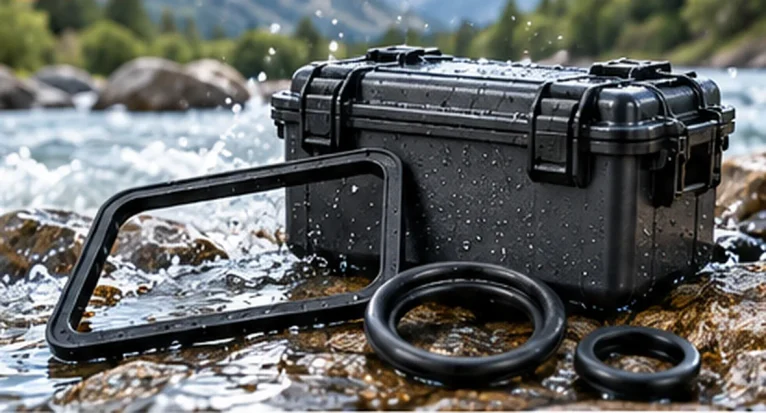
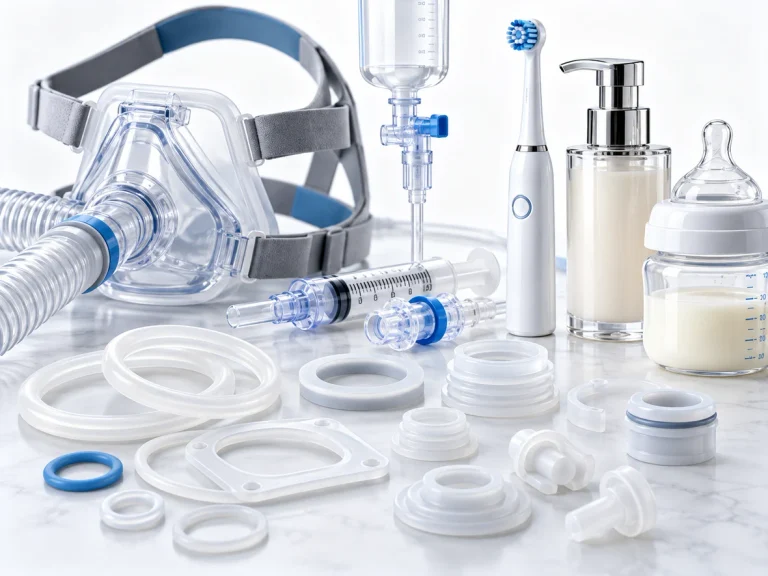
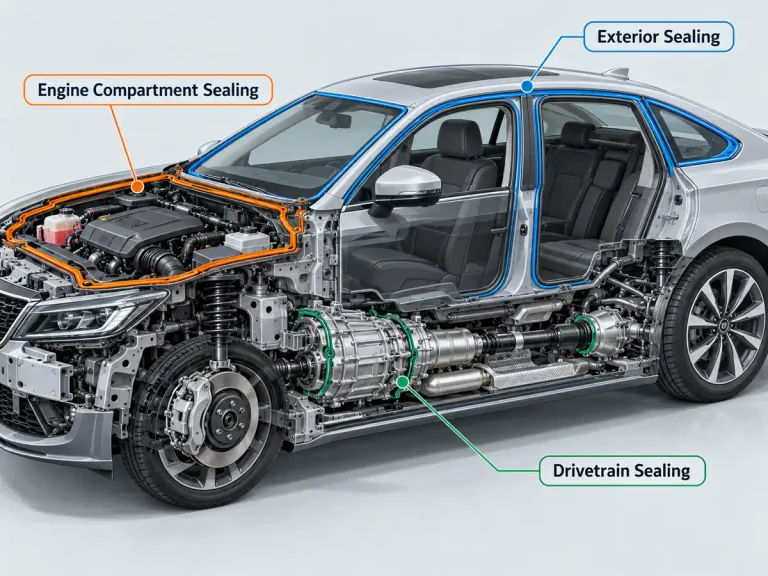
Many silicone seals fail for reasons unrelated to the material itself, and the usual cause is a wrong assumption about three things that share a timeline: cure, adhesion and service behavior. A Hersteller von Silikondichtungen ships a part that is already cross-linked, a field-applied sealant cures after it is gunned into the joint, and where a seal must be fixed to a housing, Hersteller von Teilen mit Silikon-Umspritzung production completes that bond in the mold.
Full cure is measured in days rather than minutes, and it scales with cross-section more than with the clock. A thin bead skins over in about an hour and cures through in a day, while a 10 mm section can take a week. Adhesion builds over the same window and reaches its design value only at complete cure. In static service, a correctly cured silicone seal commonly serves 15 to 20 years, and the cure it started with sets that ceiling.
The three timelines are easiest to work through in order.

How Long Does Silicone Take to Cure?
A one-part moisture-curing silicone skins over in 10 to 30 minutes and reaches full cure in 24 hours to 7 days. A two-part system cures in 24 to 48 hours at room temperature, or 4 to 8 hours with heat. Cross-section depth, temperature and humidity decide where in that range a joint lands.
Skin Time, Working Time and Full Cure Are Different
Three clock readings get reported as cure time, and mixing them up causes most supplier disputes. Skin time is when the surface stops sticking to a gloved finger, and it is what lets a bead be tooled. Working time, or pot life, is the window in which a two-part mix can still be applied, starting at mixing. Full cure is when cross-linking has run through the whole section. Specifications such as ASTM C920 report tack-free time and cure separately for that reason.
What Controls Silicone Cure Speed?
Temperature speeds the reaction up: the general rule from reaction kinetics is that a rise of about 10 degrees roughly halves the time. Treat it as a rule of thumb, because the exact relationship depends on the chemistry.
Humidity is the largest lever for one-part systems. Below roughly 40 percent relative humidity, cure can take twice as long as it does at 50 to 65 percent, and a dry production room is a common cause of a bead that looks firm but stays soft inside.
Cross-section depth matters most, because moisture has to travel from the exposed faces to the core.

| Cross-section depth | One-part at 23 °C, 50 percent RH | Two-part at 23 °C | Practical note |
| 3 mm | About 24 hours | 12 to 24 hours | Typical panel or window joint |
| 6 mm | 48 to 72 hours | 24 to 36 hours | Handling is safe much earlier |
| 10 mm | 5 to 7 days | 48 to 72 hours | Needs humidity or heat |
| Above 15 mm | May not cure through unaided | 4 to 7 days | Resize the joint or mold the part |
Two-part systems care less about humidity, but they are unforgiving of a mix that is off ratio.
Molded Silicone Seals Do Not Cure Like Applied Sealants
A molded seal arrives at the assembly line already cured, which changes what the cure question means. Liquid silicone is injected into a heated mold, cross-linked in the press and post-cured in an oven, so full mechanical properties are reached before the part is packed. For a Silicone Rubber O-Ring for Sealing, the questions are whether the post-cure brought compression set down far enough and whether the cure system leaves extractables behind. A molded part is therefore quoted with a durometer and a compression set figure, while a cartridge of sealant is quoted with a skin time.

How to Confirm Silicone Is Fully Cured
Time and conditions give a prediction; a verification step gives evidence, and it belongs on a scrap sample. Cut the bead across its section. A fully cured silicone is uniform in color and hardness from surface to center, and a visible gradient means the core is still soft. Shore A hardness can be checked with a durometer under ASTM D2240, which gives a batch-to-batch trend, though thin sections are sensitive to technique. For a bond rather than a seal, tensile adhesion testing along the lines of ASTM C1135 compares the joint against the rated value, and 80 percent of rated strength is a workable threshold.
How Silicone Adhesion Develops on Different Substrates
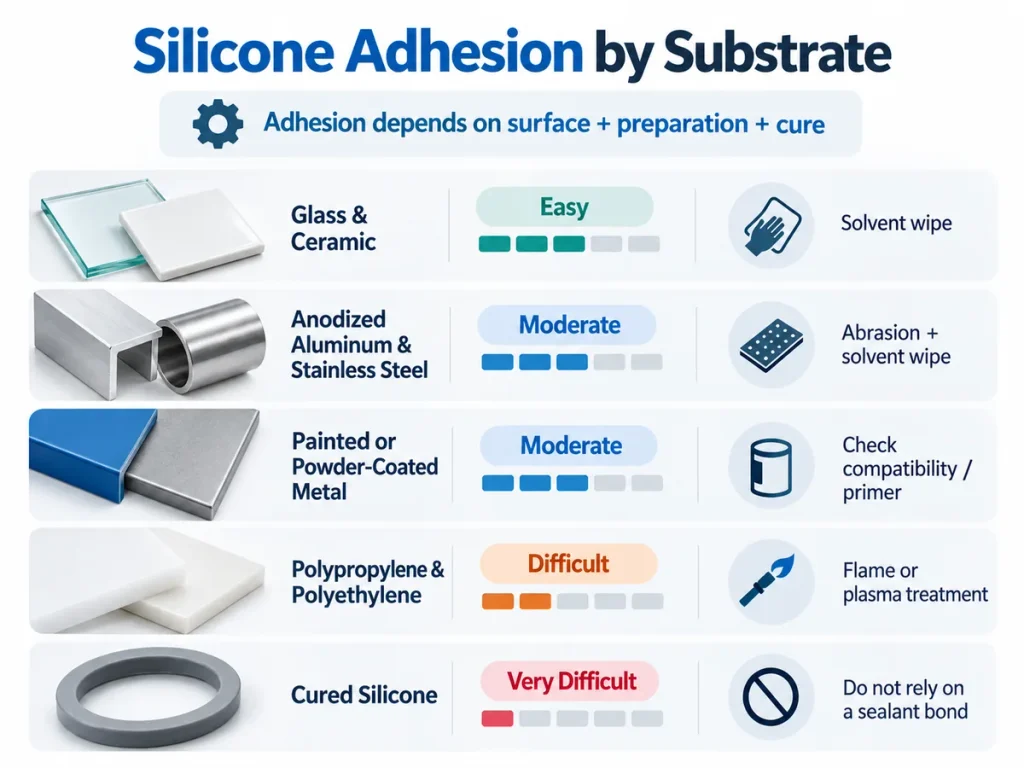
Adhesion is not a property of the sealant alone. It is a system made of the substrate surface, the way that surface is prepared, and the fully cured polymer at the interface, and it strengthens as cure advances. Silicone bonds readily to glass, anodized aluminum and most metals, needs help on low-energy plastics such as polypropylene, and will not bond reliably to a cured silicone surface at all.
Which Materials Does Silicone Bond To?
The list sorts by surface energy rather than by strength or cost. Glass, ceramic, anodized aluminum, stainless steel, painted metal and masonry all form durable bonds once clean and dry. Low-energy polymers are the problem cases, because there is little at the surface to attach to.
| Substrate | Bond difficulty | Typical solution |
| Glass and ceramic | Easy | Solvent wipe, applied dry |
| Anodized aluminum and stainless steel | Mäßig | Abrasion and solvent wipe |
| Painted or powder-coated metal | Mäßig | Confirm compatibility, primer if specified |
| Polypropylene and polyethylene | Difficult | Flame, plasma or chemical activation |
| Cured silicone | Very difficult | Do not rely on a sealant bond |
Two patterns follow. A bond that forms quickly can still be weak if the interface was contaminated, and a bond on a difficult substrate can look sound on assembly day and separate under thermal cycling. Substrate choice belongs in the same conversation as cure time, because together they decide whether silicone seals reach their rated life.
Surface Preparation and Primer Selection
Preparation decides the result, and it is the step most often shortened under schedule pressure. Abrade the surface to give the adhesive a mechanical key, wipe it with a solvent that leaves no residue, and let it flash off completely. Touch the bond face as little as possible afterwards, because skin oils reduce adhesion measurably. A primer is not a default: it is specified where the substrate is porous, where surface energy is low, or where the joint will see standing water or repeated thermal cycling, and it has to match the cure chemistry.
How to Verify Silicone Bond Strength
A bond cannot be inspected visually, so it has to be tested, and the test that matters uses the production substrate and its actual surface treatment rather than a clean laboratory coupon. Test in the condition the joint will meet in service, after water immersion and after heat aging, because a bond that passes dry can still fail wet. Cure state matters too: a bond tested at 24 hours on a thick section is being tested before the polymer has finished forming.
How Long Do Silicone Seals Last in Service?
A silicone seal does not fail on a schedule. It loses properties along four routes at once, and the rate depends on temperature, exposure and which mechanism is dominant. A correctly cured static seal commonly reaches 15 to 20 years in a benign window, and the studies behind that figure are worth reading before a supplier’s rated life is accepted.
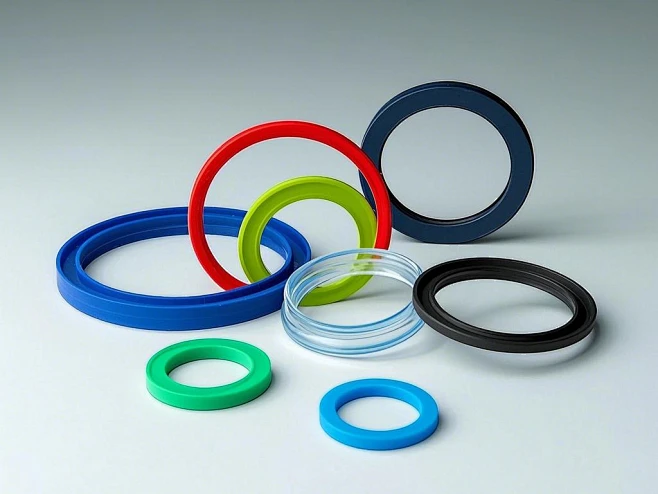
Four Main Factors That Cause Silicone Seal Failure
Four mechanisms account for most of what ends a silicone seal’s working life.
- Heat aging. Properties drift as the network sits at elevated temperature, and elongation is usually the first to move. Accelerated aging projects a shorter life from higher test temperatures, but the size of the effect depends on the formulation, so one temperature multiplier does not apply across different silicone types.
- Ultraviolet light. UV works on the surface rather than the bulk, because the silicon-oxygen backbone of Silikonkautschuk does not absorb strongly at solar wavelengths. Weathered silicone chalks and discolors at the surface instead of embrittling through its section.
- Water and steam. Room-temperature water has limited effect on cured silicone, but prolonged hot water and steam attack the network and the filler system, so a joint that survives rain can fail in a daily steam-clean cycle.
- Chemical swelling. Hydrocarbons, fuels and some solvents swell standard silicone and reduce its elastic recovery. This is the one route where the answer is normally a different polymer rather than a better cure.
The temperature and chemical limits behind each route are set out in Silicone Resistance, which is worth checking before a seal is specified into a new environment.
Why Incomplete Cure Reduces Seal Life
A seal that is under-cured at the start does not catch up the way a completed one holds. An incompletely cross-linked section is softer at the core and takes a higher compression set. Compression set is the figure to watch, because it measures how much of the squeeze the material never recovers, and a seal clamped for years has to spring back as the flange moves. The standard test is ASTM D395, and for silicone the usual condition is 22 hours at 175 °C. How compression set interacts with hardness and tolerance is covered in the Silicone Seal Specification Guide.
How to Evaluate Silicone Service Life Claims
Service life figures for silicone seals arrive in three forms, and they are not interchangeable. A material rating is a temperature or exposure limit for a compound. A warranty is a commercial promise with conditions attached. A predicted life is a model output from accelerated aging extrapolated back to service conditions, and it rests on the assumption that one failure mechanism dominates at both temperatures. Field data is the strongest evidence, and the useful detail inside it is the failure mode: a seal that fails cohesively shows the bond outlasted the material.
Planning Production Around Silicone Cure and Bonding Time
Cure time is a production constraint rather than a material curiosity, and it has to be scheduled instead of assumed. Plan backwards from the date the assembly enters service and treat the interval between application and full cure as unavailable time. For a molded part the same discipline applies to the supplier’s press cure and post-cure, which is why the cure window belongs in the purchase order, not only on the drawing.

Silicone Seal Timeline From Application to Service
An applied joint passes through five stages, each with its own owner and its own risk.
| Stage | Typical elapsed time | Governed by | What can be checked |
| Skin formation | 10 to 30 minutes | Temperature, humidity | Tacking, tooling, bead profile |
| Safe to handle | 1 to 4 hours | Cross-section, conditions | Bead no longer disturbed by touch |
| Full cure | 24 hours to 7 days | Depth, humidity, chemistry | Cross-section cut, hardness |
| Bond verification | After full cure | Substrate, treatment | Tensile adhesion against rated value |
| Service start | After release | Production schedule | Documented cure and bond records |
Read the table by row rather than by column. A cold start or an over-thick bead moves every row beneath it, and the delay surfaces on the day the line needs the parts.
Quality Checks Before Release
A short sequence of checks protects the service life described above, at almost no cost.
- Confirm the batch cure state against the stated window, and record the conditions it cured under.
- Check durometer at lot release and read the trend across lots rather than a single result.
- Cut a first article across the section and confirm a uniform core.
- Test the bond on the production substrate, wet and aged, before the first run.
- Start the service clock only at release, and keep the cure and bond records with the batch.
Häufig gestellte Fragen
Is 12 hours enough for silicone to cure?
For a bead under about 3 mm at room temperature and moderate humidity, 12 hours is enough to handle the part, but not enough to call it cured. Above roughly 6 mm it leaves a soft core. Treat 12 hours as a handling milestone, not a cure time.
Does a silicone seal keep curing after it goes into service?
An applied moisture-curing sealant does, and it often cures faster in service than in the workshop. A molded seal does not: it arrives fully cross-linked and only changes afterwards through aging. That matters when a warranty is dated from delivery rather than from cure.
Does silicone stick to cured silicone?
Not reliably. Cured silicone has very low surface energy, and a fresh bead laid over it will often peel at the interface rather than tear. Joining cured silicone to cured silicone normally needs a mechanical interlock, a purpose-made adhesive, or a treatment that raises the energy of the old surface.
Can an applied silicone sealant bead replace a molded silicone seal?
Only where the joint is assembled once, sealed and never reopened, which is where a formed-in-place bead is cheaper. Where the joint is opened for inspection or repair, or where thousands of units must behave identically, molded silicone seals with documented properties are the more reliable choice.
How can silicone cure be accelerated without weakening the bond?
By controlling conditions rather than by applying heat indiscriminately. Raise ambient temperature within the limits of the compound, keep relative humidity above about 50 percent for one-part systems, and reduce cross-section where the design allows. Two-part systems tolerate heat well, while a hot-air blast on a one-part bead dries the surface and can trap an uncured core.