Fluid control shows up in places most people never think about. A ketchup bottle that doesn’t drip, a medical respirator that stops backflow, and a dishwasher brush that releases soap on demand. These small jobs depend on a part that’s easy to overlook: the silicone valve.
A silicone valve is an elastic, pressure-actuated component made from silicone rubber that opens to let fluid or gas pass and closes to seal when pressure drops. It does two jobs at once: it seals a container and it meters how much liquid or air comes out. Unlike metal or rigid plastic valves, it has no spring, no actuator, and no moving assembly beyond the silicone itself.
Below, we’ll walk through what these valves are, how they work, the main types you’ll meet, where they’re used, how they’re manufactured, and how to pick the right one for a given product. You can also review the full range from a custom silicone valve before specifying a part.
What is a silicone valve?
A silicone valve is a one-piece elastomeric part that controls flow using the flexibility of silicone rather than mechanical parts. It’s molded into a shape that rests closed and opens only when enough pressure builds up.
Silicone valves belong to a broader family of elastomeric or “rubber” check and dispensing valves. The material is silicone rubber, chosen because it stays flexible across a wide temperature range, resists many chemicals, and can be made in grades safe for food and medical contact. The valve’s job is to manage the movement of liquids, gases, or even fine powders through a narrow opening.
What makes the design useful is its simplicity. There’s no ball, no spring, no solenoid. The silicone itself flexes. Under no pressure, the slit, flap, or lip sits in contact and blocks the passage. Apply pressure from the correct side, and the silicone deforms enough to open a path. Remove the pressure, and the material springs back to its sealed shape. That self-resetting behavior is why these valves appear in products that need thousands of repeat cycles without a service call.
Compared with a rigid valve, a silicone part adds almost no weight and needs no power. It also tolerates misalignment and vibration better, since the soft material conforms instead of binding. The trade-off is that performance depends heavily on geometry and material choice, which is why specification matters more than with a generic off-the-shelf fitting.
How does a silicone valve work?
A silicone valve works by responding to pressure differences: it stays shut until fluid or gas pressure overcomes the silicone’s resistance, then snaps back to seal when that pressure falls. The motion comes from the material’s elasticity, not from any separate mechanism.
The core idea is differential pressure. The valve has a “downstream” and an “upstream” side. In a dispensing valve, pressure on the upstream side (say, a finger squeezing a bottle) pushes the silicone open. In a check valve, flow in the allowed direction opens the passage, while flow trying to go backward presses the silicone shut.
Sealing vs. dispensing in one part
A common misunderstanding is that a valve either seals or dispenses. A silicone valve does both. At rest, the same lip or slit that will later release product forms a tight barrier against leaks and outside air. When pressure arrives, that same feature becomes the outlet. This dual role is what lets a product ship without a separate cap liner or gasket. The valve is the seal and the dosing point in a single molded piece.
Pressure differential and cracking pressure
Every silicone valve has a cracking pressure: the minimum pressure needed to open it. Get below that number and it stays closed; cross it and flow begins. Cracking pressure depends on wall thickness, slit length, durometer (hardness), and geometry. A thin cross-slit in soft silicone opens at very low pressure, which suits squeeze bottles. A stiff duckbill in firmer material needs more force, which suits pressurized lines that must not weep. Designers tune these variables instead of adding parts.
There is also a small gap between the pressure at which the valve opens and the pressure at which it fully reseals, often called hysteresis. In most dispensing parts this is minor and helps a clean cutoff. In precise medical or metering uses, it’s worth measuring so the dose stays consistent across the product’s life.
.webp)
Common types of silicone valves
Silicone valves come in several shapes, each tuned for a different flow pattern: cross slit, duckbill, umbrella, flapper, conical, dome, and fully custom geometries. The shape decides how the silicone deforms and what kind of flow it allows.
Silicone cross slit valve
The silicone cross slit valve gets its name from a cross-shaped, star-shaped, or asterisk-shaped cut in a flat disc. At rest the cut stays closed. Squeeze the container and the slits part to release the product, then close again to stop drips. It’s the standard choice for condiment and sauce bottles, syrups, and personal-care tubes. Public mold sizes commonly run around 9.8 mm, 10.5 mm, and 16.5 mm outside diameter, with slit openings scaled to the product’s viscosity. Makers usually run an inverted leak test over several days and check the dispensing angle so product lands where it should.
Because the slit is the only opening, the cut quality decides everything. A ragged or uneven cut drips; a clean, centered cut gives a tight seal and a predictable stream. That’s why high-volume cross-slit production leans on automated punching rather than hand cutting.
Silicone duckbill check valve
The silicone duckbill check valve looks like a duck’s bill and acts as a one-way passage. Forward pressure opens the bill; reverse pressure flattens it shut. That makes it a true silicone one-way valve, suited to preventing backflow in medical tubing, automotive lines, and industrial systems. It can also pair with an umbrella valve to build a two-way flow controller in one assembly. Standard public tooling often sits near 12.5 mm outside diameter, with custom bill lengths and angles made to the drawing.
What sets the duckbill apart is its directional discipline. It doesn’t just limit flow; it actively blocks reverse movement, which is why it’s trusted in places where backflow would be a safety or contamination issue rather than a minor nuisance.
Silicone umbrella valve
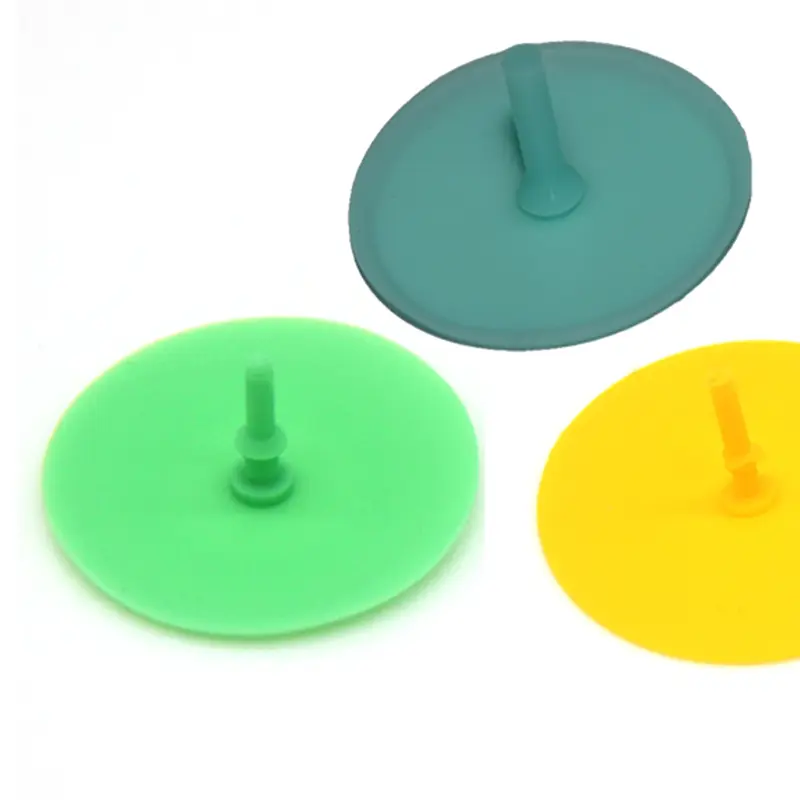
The silicone umbrella valve (sometimes called a mushroom valve) uses a flexible canopy that lifts off its seat under pressure and presses back down to close. It handles low cracking pressures well, which is why it shows up in water bottles with flavor chambers, breathing devices, and vent paths in appliances. Its gentle opening makes it good for applications where a hard “pop” would be a problem or where flow must start at very low pressure.
The umbrella form also seats well against a flat or stepped housing, so it often needs no extra gasket. That simplifies the surrounding assembly and removes a failure point.
Flapper, conical, dome, and customized valves
The flapper valve is a one-piece hinge-style part that swings open for high-flow dispensing, common in first-in-first-out sauce bottles and some medical check uses. The conical valve carries an asterisk slit for precise micro-dosing, used in eye-cream applicators. The dome valve has an undercut that snaps straight into a housing without a plastic seat, seen in soap-dispensing dish brushes. Beyond these, makers produce custom silicone valves to a customer’s 3D model, tuning hardness, color, overmolding, and performance targets like cracking pressure and flow curve.
Custom work usually starts from a drawing or sample plus the intended use and the open and close pressures. For sensitive applications, suppliers will often sign a non-disclosure agreement before sharing geometry details.
Where are silicone valves used?
Silicone valves are used wherever a product needs clean sealing plus controlled release: food and beverage, personal care, medical devices, home appliances, automotive, and electronics. Each sector leans on different valve types for different reasons.
Food, beverage, and personal care
In food and drink, the priority is no-drip dispensing and hygiene. Cross-slit valves govern ketchup, mayonnaise, syrup, vinegar, and concentrates. In personal care, the same precision controls lotions, serums, and creams without mess. Because silicone resists flavor pickup and cleans easily, it fits products that must taste or smell right every time.
Medical devices and healthcare
Medical uses demand biocompatibility and reliable one-way flow. Silicone one-way valve designs appear in catheter systems, respiratory circuits, and infusion paths where backflow could cause harm. Umbrella and duckbill forms are common because they open at low pressure and reseal tightly. These parts are often made in clean environments and verified against flow, leak, and fatigue limits.
Home appliances, automotive, and electronics
Appliances use silicone valves for venting, pressure relief, and leak control: dishwasher brushes, water tanks, and coffee systems. Automotive and electronics use them for breather vents that block water and dust while letting air move and for managing fluids in sensors and small reservoirs. Their chemical stability and temperature range make them a fit where plastic would warp or crack.
Beyond the familiar sectors, silicone valves also appear in environmental and agricultural gear. Drip-irrigation emitters and chemical-metering devices use them to release small, repeatable amounts of liquid without a powered pump. In each of these cases the appeal is the same: a passive part that keeps working without maintenance.
How are silicone valves made?
Silicone valves are made by either compression molding of solid silicone or liquid silicone rubber (LSR) injection molding, with the choice driven by volume, precision, and color needs. Both start from silicone stock and end with a cured, elastic part.
Compression molding for solid silicone
Compression molding places a pre-formed slug of solid silicone in a heated mold and presses it to shape. It suits smaller runs, colored parts, thicker sections, and lower tooling costs. The trade-off is looser dimensional control and more manual handling than injection. It remains popular for custom or low-volume orders where speed to tooling matters more than micron-level repeatability.
Solid silicone also handles pigments and fillers well, so it’s the go-to when a valve needs a specific color for branding or part identification. The curing step is slower per shot, which is acceptable when the annual volume doesn’t justify automation.
LSR injection molding for precision parts
LSR injection molding feeds two-part liquid silicone into a heated cavity, where it cures into a precise, often transparent part. It shines for high-volume, food- and medical-grade production where dimensions must hold across millions of cycles. Automated lines can punch the slit and inspect every piece optically, lifting yield and daily output. For cross-slit valves, automated cutting and full inspection keep the dispensing angle and slit depth consistent.
LSR’s tight control comes from metering the two components at a fixed ratio and injecting into a closed mold, which removes much of the variation found in manual loading. That consistency is why regulated industries lean toward LSR when volumes allow.
Material grades and quality considerations
Material choice comes down to two grades, food and medical, plus controls like cleanroom production and leak and flow testing that prove the part behaves as specified. The grade sets what the valve may safely touch.
Food-grade silicone meets rules for contact with edibles; medical-grade silicone meets stricter biocompatibility expectations for devices that touch the body. Hardness typically spans about 20 to 70 Shore A, with softer material giving lower cracking pressure. Production often happens in a Class 100,000 cleanroom for sensitive parts, and finished valves go through leakproof, opening-pressure, flow-rate, and sometimes noise testing.
Quality systems behind these parts commonly carry ISO 9001 for general manufacturing, ISO 13485 for medical devices, and IATF 16949 for automotive supply. A buyer should ask which certifications apply to the specific part, not assume a generic “silicone” claim covers every use. Transparency, color, and post-cure steps also affect whether a part meets a given standard, so the spec sheet should list them explicitly.
How to choose the right silicone valve
Choosing the right silicone valve means matching the fluid and operating conditions to a valve shape, material grade, and manufacturing process, then proving it with a prototype. A short, structured path keeps the decision from becoming guesswork.
Start by defining the fluid: its viscosity, temperature, and whether it’s liquid, gas, or powder. Note the target flow rate and the pressure available to open the valve. Next, pick a structure. Squeeze-dispensing sauces point to a cross-slit; tube-based medical backflow control points to a duckbill or umbrella; high-flow FIFO bottles suit a flapper; micro-dosing creams suit a conical. Then decide on the material and process: food or medical-grade, solid compression or LSR injection, and the hardness that gives the right cracking pressure. Finally, validate with a prototype and functional, fatigue, and temperature-cycle tests before committing to production. Prototypes often turn around in roughly one to two weeks, after which formal validation documents the part’s behavior.
The table below maps common needs to a starting valve type.
| Need | Starting valve type | Why |
| Squeeze-bottle sauce or syrup | Cross slit | Clean cutoff, controlled angle |
| One-way medical backflow block | Duckbill or umbrella | Reliable seal, low open pressure |
| Appliance venting or relief | Umbrella | Gentle opening, compact |
| High-flow FIFO dispensing | Flapper | High throughput, simple part |
| Precise cream micro-dose | Conical | Asterisk slit, small metered amount |
A good selection also weighs cost and volume. Low runs may favor compression molding; high runs with tight specs favor LSR. When the application is unusual, a custom geometry built to the drawing often beats forcing a standard shape to do a job it wasn’t meant for. Bringing the valve supplier in early, while the housing is still being designed, usually saves the most rework later.
FAQ
Can a silicone valve handle both liquids and gases?
Yes. The same elastic opening that meters a liquid can also vent or pass gas, which is why silicone valves appear in both dispensing closures and breather vents. The right shape and cracking pressure decide which behavior dominates.
What’s the difference between a duckbill and an umbrella valve?
Both are one-way silicone forms, but they open differently. A duckbill flattens open along a bill and is strong at blocking reverse flow, while an umbrella lifts a canopy off its seat and is known for low opening pressure and gentle flow.
How long does a silicone valve last in repeated use?
Life depends on durometer, geometry, fluid, and cycle pressure, but well-made parts are rated for thousands to millions of cycles. Validation testing against the real fluid and pressure range is the only reliable way to confirm a specific service life.