Silicone one-way valves sit inside products most people never notice: a coffee bag that vents without letting air in, a medical respirator that keeps air moving the right way, and a lotion bottle that dispenses without leaking back. They are small, soft, and quiet, yet they carry a job that matters in food safety, patient care, and engine reliability. A custom silicone valve built for one-way flow solves a problem that rigid metal valves often handle at a higher cost and larger size.
A silicone one-way valve prevents backflow by opening only when fluid or gas pushes in the allowed direction and sealing shut the moment pressure reverses, so nothing can travel back through the same path.
The sections below explain how that sealing action works, the main forms these valves take, and where they fit into real products.
What a silicone one-way valve is
A silicone one-way valve is a flexible elastomer part that lets media move in a single direction and blocks it from returning, using the spring-like memory of silicone rubber instead of a metal mechanism.
Engineers call it several names that mean the same job. A check valve, a one-way valve, and a non-return valve all describe a device built to permit flow in one direction and stop it in the other. When people ask what valves prevent backflow, the honest answer is any of these: the term changes with the industry, not the function. The silicone version does the work with a soft part that flexes open and closes on its own.
Silicone rubber, or VMQ, gives these valves traits that metal and many plastics cannot match. It stays flexible across a wide temperature span, shrugs off many chemicals, and holds its shape after repeated squeezing. That elasticity is the whole trick: the valve does not need a spring because the material itself returns to the sealed position. The same property lets the part survive thousands of open-close cycles without fatigue that would crack a rigid seal.
Why backflow is a problem
Backflow turns a safe system into a risky one. In a beverage package it pulls oxygen and bacteria toward the product, cutting shelf life. In a medical line it can drive contaminants toward a patient or a clean source. In a fuel or coolant path, it lets pressure spike and damage seals. A one-way valve removes that return path before it can open, which is why specifiers reach for it early in design rather than as a fix later.
How a silicone one-way valve stops backflow
It stops backflow through pressure alone: forward pressure flexes the silicone open, and the instant flow reverses the same material, which snaps back to its seat and seals, with no external power or moving parts beyond the rubber itself.
The action depends on a balance of forces. When media pushes in the allowed direction, it lifts or parts the sealing lip and flows through. When the push stops or reverses, the pressure on the back side presses the lip against its seat, and the gap closes. The valve resets every time because silicone keeps its elastic memory, so it does not drift out of calibration the way a worn spring might.
How easily it opens comes down to a few physical facts. Softer rubber and thinner walls open at lower pressure. A smaller flow area or a tighter seat needs more pressure to part. Makers tune hardness, wall thickness, and seat shape to hit a target cracking pressure, the point where the valve first opens. That is why one silicone valve can suit a gentle lotion pump while another holds firm in an engine line.
There is also a small gap between the pressure that opens the valve and the pressure that keeps it fully open, a behavior engineers call hysteresis. In most silicone valves this gap is tiny, which is good: the seal stays predictable across a range of flow rates. When a design needs a very sharp open-close point, the slit geometry and wall thickness get tuned until the curve is as steep as the application allows.
Main types of silicone one-way valves
The common forms are umbrella, duckbill, and cross-slit valves, each shaped so the silicone opens and closes in a different way to match the product around it.
Each shape fits a different housing and a different flow need. The list below covers the three you will meet most often in spec sheets and quotes, with a fourth worth knowing for larger lines.
Silicone umbrella valve
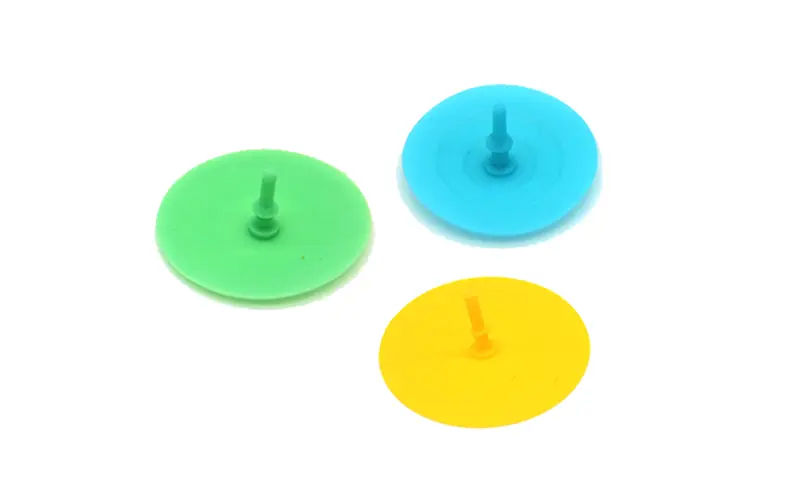
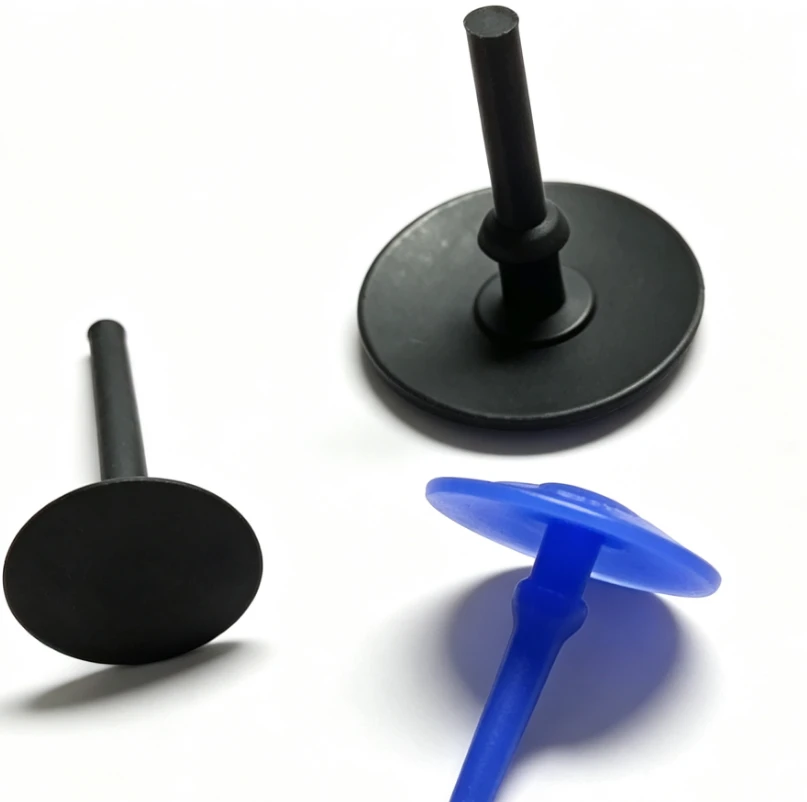
A silicone one-way valve looks like a small mushroom. Its stem passes through a hole in a flat seat, and the skirt sits on top. Forward pressure lifts the skirt off the seat and lets media pass; when pressure drops, the skirt drops back and seals. It suits housings where the valve clamps between two molded surfaces, and it handles both air and liquid. Designers like it because the seat can carry slots or banana-shaped orifices to raise flow without losing seal support.
Silicone duckbill check valve
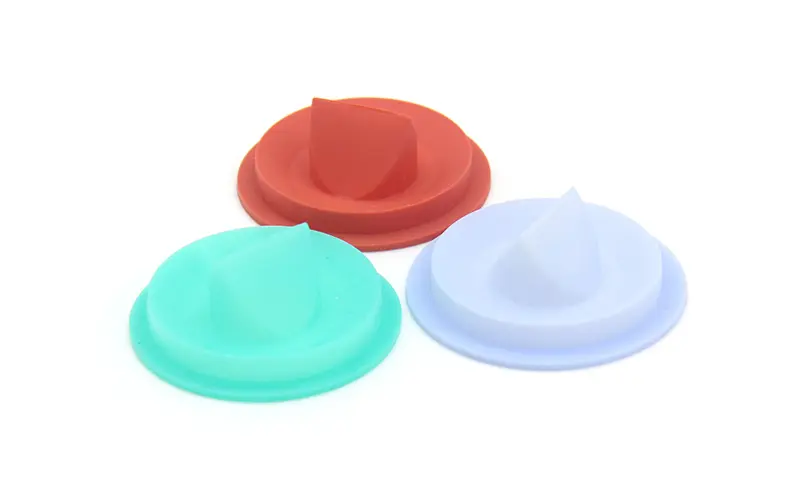
A silicone duckbill check valve takes its name from the bill-like lips at its tip. Those lips stay parted under forward flow and press together the moment reverse pressure arrives, closing to a seal. One useful trait is that it works in any position, so the product designer need not worry about orientation. You will find it in medical tubing, breast pumps, fuel lines, and dispensers. It also leaves almost no dead volume, which matters when the medium must not stagnate or when the path must stay clean.
Silicone cross slit valve
A silicone cross slit valve carries one or more slits cut across a flat face. It stays closed until pressure reaches a set point, then the slit opens just enough to meter the medium out, and it closes again as pressure falls. That makes it a fit for precise dispensing where the amount per press matters, such as cosmetic and sauce packs. A single cross slit gives a round opening; multiple slits give a star pattern that spreads the medium more evenly.
Flapper and other forms
A rubber flapper valve uses a hinged flap that swings open with forward flow and drops back under reverse pressure. It fits larger passages where an umbrella or duckbill would be too small. The point across all forms is the same: shape the silicone so forward pressure opens it and reverse pressure closes it, then pick the shape your housing already supports.
Silicone and other elastomer material choices
Silicone (VMQ) covers most applications, while fluorosilicone (FVMQ) steps in when the medium is oil-based or the temperature runs to extremes.
The rubber grade should follow the medium, not the other way around. Picking the wrong compound can mean swelling, cracking, or failed certification, so the choice starts with what touches the valve. Hardness also plays a role: most silicone valve stock lands below 55 Shore A, soft enough to seal yet firm enough to demold and hold shape.
Medical-grade silicone
For medical and pharmaceutical use, silicone that passes USP Class VI and ISO 10993 biocompatibility tests is the standard. These grades tolerate gamma and steam sterilization, which matters for reusable or patient-contact parts. A respirator valve or an IV line component will almost always call for this class of silicone, and the documentation behind the grade is as important as the part itself.
Food-grade and potable water silicone
Food and drinking-water paths need silicone cleared under FDA, REACH, and ROHS rules. The point is that nothing leaks into the product, and the valve stays safe through normal use and cleaning. Coffee bags, bottle caps, and dispenser spouts fall in this group. Where the valve meets a consumer, the certification is what lets the product clear customs and pass audit.
Fluorosilicone for automotive and temperature extremes
When the medium is fuel, oil, or a wide temperature swing, fluorosilicone (FVMQ) earns its place. It resists petroleum fluids that plain silicone does not, and it stays useful from about −40°C up to 200°C. Automotive non-return valves and industrial lines often specify it for that reason. Other elastomers like NBR or EPDM cover some ranges but sit in a narrower band, roughly −20°C to 120°C, so they lose out where the swing is wide.
Where silicone one-way valves are used
They show up wherever a product must let something out or in without letting it come back, across medical, food, personal care, and vehicle systems.
The same simple part solves different problems in different industries, which is why demand keeps growing. What changes from one use to the next is the medium, the pressure, and the certification, not the basic idea.
Medical devices
In medical devices the valve guards air and fluid paths. Respiratory equipment uses it to keep airflow one-way, manual resuscitators use it to deliver each breath, and infusion kits rely on it to stop retrograde flow. Heart-surgery tubing circuits use duckbill forms for the same reason: no dead volume, no orientation worry. Here, a silent failure is not an option, so material certification and inspection carry real weight.
Food and beverage packaging
Food and beverage packaging uses the valve to vent gas while blocking outside air. Coffee and snack bags release trapped gas through a silicone one-way valve and stay fresh inside. Squeeze bottles use it to dispense without sucking air back in. The valve protects flavor and shelf life at once, and because it is passive, the pack needs no cap feature or moving part to do the job.
Personal care dispensers
Personal care products use cross-slit and duckbill forms to control dose. A shampoo or lotion bottle gives a clean amount per press and keeps the contents from leaking back toward the reservoir. The soft seal also stops the product from drying at the tip, which is the complaint that drives people to throw a half-full bottle away. Soap and sanitizer dispensers use the same principle on a larger scale.
Automotive and industrial systems
Automotive and industrial systems use these valves in fuel, oil, and coolant paths where a small non-return element prevents pressure loss and protects pumps. Fluorosilicone grades handle the harsh media, and the part’s size lets designers place it where a metal check valve would not fit. One-way fuel pumps in cars and planes rely on duckbill forms for exactly this reason: small, light, and position-free.
How manufacturers make silicone one-way valves
Production runs from mold design through molding, slit cutting, and final inspection, with each step set to hold the valve’s sealing shape within tight limits.
The part looks simple, but the process behind it is not. Small defects in the seal edge decide whether the valve works, so control matters at every stage and gets tighter as volumes rise.
Mold design and silicone molding
It starts with mold design, where the stem, skirt, and seat geometry get fixed. The silicone then takes shape by compression molding, where pre-measured rubber is pressed in a heated mold, or by liquid silicone rubber (LSR) injection molding, where liquid silicone is injected and cured. LSR suits high-volume, tight-tolerance runs because the machine meters the material and the cure is consistent; compression fits lower volumes and simpler shapes where tooling cost must stay low.
Slit cutting and inspection
After molding, the slit gets cut, either by a blade or an automated punch, to the exact length and depth the flow needs. Inspection follows, often with automated optical systems that catch bubbles, nicks, or off-size seals, and a sample or full check before shipping. A missed slit defect shows up as a valve that leaks backward, so this step closes the loop. Packaging also matters: valves often ship in bags with a little air inside so they do not deform in transit.
Alternatives to a mechanical backflow preventer
A silicone one-way valve is a passive, low-cost alternative to spring-loaded or float-type backflow preventers, trading some pressure rating for size, weight, and price.
When a spec calls for backflow protection, a designer has more than one route. A spring check valve uses a metal spring to close and handles higher pressure, but it costs more and takes space. A vacuum breaker or an air gap solves backflow in plumbing by breaking the path with air, though neither fits a sealed package or a small device. A gravity or flap design works in drains but needs a set orientation and a vertical run.
The silicone check valve earns its place where the system is small, the medium is mild, and the opening pressure is low. It asks for no power, adds almost no weight, and costs little at volume. It will not replace a heavy industrial preventer rated for high pressure, but for most consumer and medical products it is the simpler answer, and it removes a failure point by removing the spring.
How to choose the right silicone one-way valve
Choose by matching the medium, opening pressure, temperature, and certification to a valve type, then confirm the housing can seat and support the seal.
Start with the medium and the rules it brings. Food and skin contact need food-grade silicone; patient contact needs medical-grade. Next, set the cracking pressure: a lotion pump wants a low figure, and a fuel line wants a higher one. Temperature and chemical exposure then point to silicone or fluorosilicone, and hardness follows from how soft the seal must stay.
The table below maps the common types to the jobs they fit best.
| Valve type | How it opens | Best fit | Typical medium |
| Silicone umbrella valve | The skirt lifts off a flat seat | Molded housings, air, and liquid | Air, water, mild fluids |
| Silicone duckbill check valve | Lips part, then seal on reverse | Position-free, medical, and fuel lines | Air, gas, fuel, liquid |
| Silicone cross slit valve | Slits open at set pressure | Precise dispensing | Creams, sauces, gels |
After the type, check the seat. The housing must give the valve a clean, supported surface to close against, or it will weep backward under pressure. Bringing a silicone valve manufacturer into the design stage early saves rework, because the seat and orifice are easier to tune with their input. Flow rate sets the orifice size: larger orifices raise flow but thin the seat, so the designer balances the two. A quick prototype test under real pressure catches most issues before a full run, and it is cheaper than finding them in the field.
FAQ
How long does a silicone one-way valve last?
Life depends on the medium, temperature, and how often it flexes. In mild, room-temperature use a valve can run for years; in hot or chemical-exposed lines the rubber ages faster and may harden or swell. Picking the right grade and keeping it inside its temperature band is the main way to extend service life.
Can silicone check valves be sterilized?
Medical-grade silicone tolerates gamma irradiation and steam (autoclave) sterilization, which is why it appears in reusable devices. Fluorosilicone also withstands heat but should be checked against the exact sterilization cycle before use, since repeated autoclaving can shift its hardness over time.
What opening pressure do silicone one-way valves need?
They open at a set cracking pressure tuned by hardness, wall thickness, and seat shape rather than by a fixed property of silicone itself. Gentle dispenser valves may open near a few kilopascals, while industrial grades need more. The figure is a design choice, so it should be set from the application, not assumed from the material.