
Control panels still run on two technologies. One is a molded sheet of silicone rubber with raised keys. The other is a laminated stack of printed polyester film. Both replace discrete mechanical switches, both cost less, and both seal a panel face against dust and water. Most keypads today are produced by LSR injection molding or by compression molding, while membrane switches are screen-printed and die-cut. On a drawing the two look interchangeable. In the field they behave very differently.
Choose a silicone keypad when operators press often, wear gloves, work outdoors, or wipe the panel down with harsh chemicals. Choose a membrane switch when the panel must be thin, carries dense graphics, ships in a short run, or has to hit an aggressive unit-cost target. Silicone gives you travel, a real snap, and a much wider temperature range. Polyester film gives you thickness savings, print quality, and lower tooling costs.
The sections below walk through construction, measured performance, cost behavior, and the specification data you should have ready before you ask for a quote.
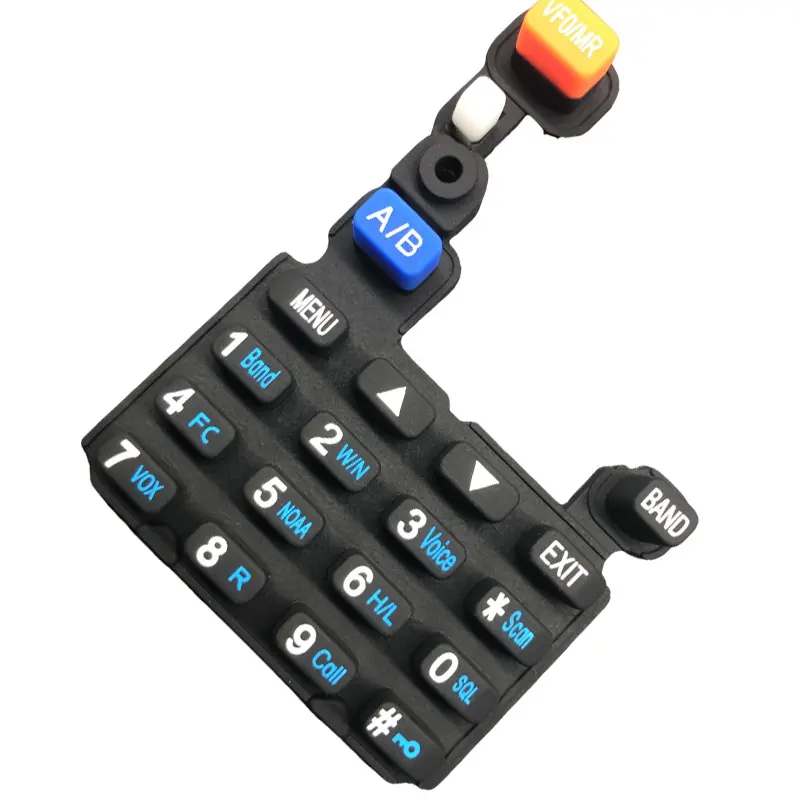
What is a silicone keypad?
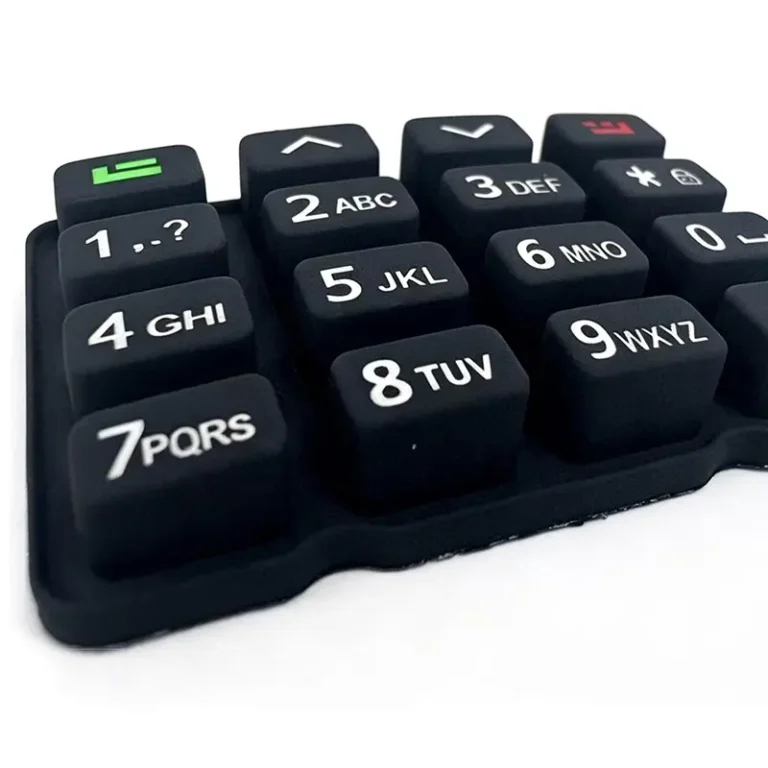
A silicone keypad is a single molded sheet of silicone elastomer with raised keys formed into it. Each key stands on a thin, flexible wall called a web. Pressing the key buckles that web, and the buckling is what your finger reads as a click.
| Part | What it does | Typical specification |
|---|---|---|
| Keymat | One molded sheet carrying every key | 1.5–4.0 mm overall thickness |
| Web | Flexure wall that sets force and feel | Tuned by wall thickness and draft angle |
| Contact pill | Bridges the pads on the board below | Carbon-filled silicone at roughly 200 Ω; gold-plated options for low-resistance logic |
| PCB pad | Interdigitated contact pattern under each key | Gold flash over nickel on copper |
| Bezel or backer | Compresses the mat against the board | Plastic or metal, bonded with acrylic transfer tape |
How a keypress becomes a signal
- Finger force pushes the keytop down.
- The web deflects, then buckles once the peak force is reached.
- The contact pill drops onto the PCB pad and closes the circuit.
- The controller registers the press.
- Releasing the key lets the web spring back, lifting the pill and opening the circuit again.
Three points on the force-stroke curve matter in a specification:
- Peak force—the maximum resistance before the web collapses.
- Return force—the push you feel on the way back up.
- Contacto force—the force held while the circuit stays closed.
The snap ratio is peak force divided by contact force. Silicone keypads usually land between 1.3:1 and 2.5:1. 1. Higher ratios feel crisper, lower ratios feel softer, and both have a place depending on whether the operator is wearing gloves.
How silicone keypads are made
Compression molding presses solid silicone rubber into a heated cavity. It suits larger parts, harder durometers, and lower volumes. Liquid silicone rubber injection molding meters a two-part compound, injects it into a closed tool, and cures it in seconds, holding tighter tolerances with less flash. Both routes produce the same finished geometry. The choice usually comes down to volume, tolerance, and whether the part needs overmolding or two durometers in one shot.
Key durometer normally sits between 40 and 70 Shore A, with 25 to 85 available. Softer keys feel lighter and wear faster. Harder keys transmit more force into the board and can shorten pad life.
What is a membrane switch?
A membrane switch is a laminated assembly of thin polyester films. Pressing a key area pushes the top circuit layer through a cut-out in a spacer until it touches the bottom circuit layer. The finished stack is usually under 1.5 mm thick and carries printed graphics on its face.
| Layer | Material | Typical thickness | Function |
|---|---|---|---|
| Graphic overlay | Polyester or polycarbonate | 0.125–0.250 mm | User-facing graphics, printed on the underside |
| Top circuit | Polyester printed with silver-filled ink | 0.125 mm | Upper contact pads |
| Spacer | Polyester with die-cut apertures and vent channels | 0.10–0.25 mm | Holds contacts apart; vent channels run 0.5–1.0 mm |
| Tactile dome (optional) | Stainless steel or formed polyester | 6–16 mm diameter | Adds snap and audible feedback |
| Bottom circuit | Polyester printed with silver-filled ink | 0.125 mm | Lower contact pads and tail exit |
| Rear adhesive | Acrylic pressure-sensitive tape | — | Bonds the assembly to the enclosure |
| Rigid backer (optional) | Fiberglass laminate or aluminum | 0.8–1.6 mm | Dimensional stability |
Tactile and non-tactile builds
A non-tactile switch gives no physical feedback. Confirmation comes from an LED, a beep, or a screen change. Because nothing snaps, these builds tend to survive more actuations and cost less.
A tactile build adds a dome. Stainless steel snap domes run from 150 to 450 gf and give a sharp, audible click. Polyester domes are formed directly into the spacer or overlay, feel softer and quieter, and have a shorter cycle life. Embossing the overlay adds 0.10 to 0.50 mm of relief so operators can find a key without looking.
Circuits, tails, and connectors
Silver-filled conductive ink is the default conductor, at roughly 30 to 80 mΩ per square at 10 μm dry film thickness. Etched copper on flexible polyester costs more and performs better, particularly where trace length is long or the environment is corrosive. Silver is vulnerable to sulfur attack, so copper or carbon overprint gets specified in harsher duty.
The tail exits the bottom circuit layer and terminates in a ZIF connector at a 0.5, 1.0, or 1.27 mm pitch or in soldered and crimped terminations. Vent channels routed from each key opening to the perimeter stop the stack from locking up pneumatically during fast actuation and equalize pressure with altitude changes.
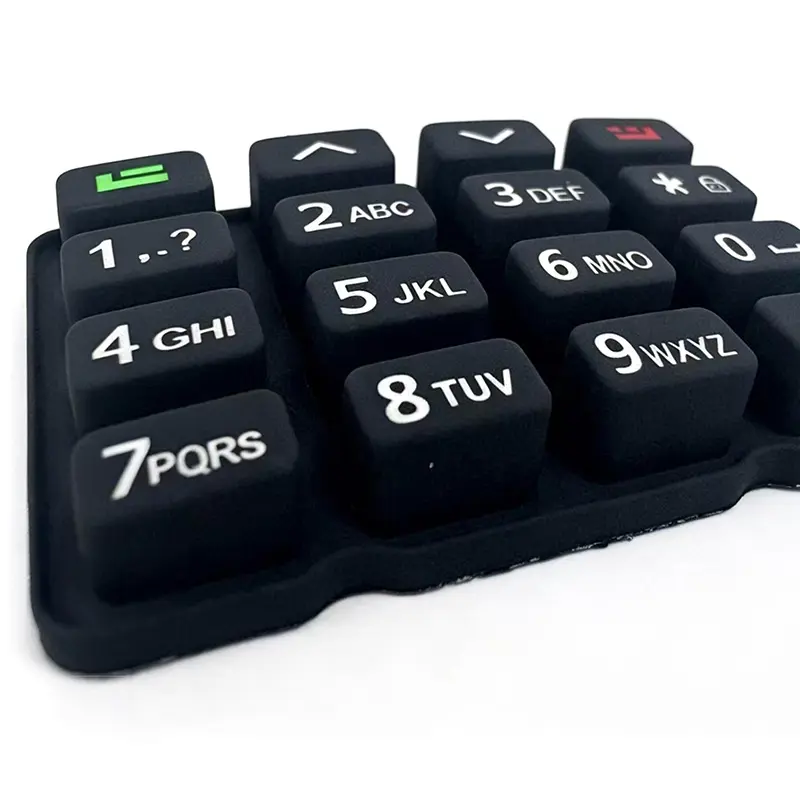
Silicone keypad vs. membrane switch: the head-to-head numbers
Silicone wins on travel, tactile feel, temperature range, chemical resistance, and service life. Membrane switches win on thickness, graphic quality, backlighting cost, and tooling cost. Cycle life overlaps heavily, and unit price depends more on volume than on technology.
| Criterion | Silicone keypad | Membrane switch |
|---|---|---|
| Key travel | 0.5–2.5 mm | 0.1–0.5 mm |
| Actuation force | 150–450 gf | 100–500 gf with a dome; 50–1000 gf custom |
| Snap ratio | 1.3:1 to 2.5:1 | 1.5:1 to 3.0:1 with a metal dome |
| Cycle life | 500,000 to 10 million | 500,000 to 5 million; up to 10 million with metal domes |
| Operating temperature | -50 °C to 200 °C | -30 °C to 85 °C |
| Sealing | IP65 to IP68, sealed by the mat itself | IP54 to IP68, sealed at the perimeter |
| Contact resistance | Around 200 Ω for carbon pills | Under 100 Ω standard, under 10 Ω high-end |
| Chemical resistance | Excellent; resists alcohols, mild acids, and alkalis | Moderate; polyester is attacked by strong alkalis. |
| Overall thickness | 1.5–4.0 mm | 0.5–1.5 mm |
| Graphics | Screen print, laser etch, molded legends | Full-color digital print, transparent windows |
| Backlighting | Laser-etched keys, light pipes, light guide film | LED, electroluminescent, light guide film at a lower cost |
| Custom key shapes | Fully three-dimensional | Embossing only, 0.10–0.50 mm |
| Unit cost at 10,000 pieces | $0.50 to $5.00 per keypad | $0.30 to $2.00 per assembly |
| Tooling cost | $3,000 to $25,000 | $500 to $3,000 |
Tactile feedback and travel
Travel is the difference operators notice first. A silicone key moves 0.5 to 2.5 mm before contact, which is enough to feel through a work glove and enough to support blind operation. A membrane key moves 0.1 to 0.5 mm, and without a dome there is no snap at all, only the sensation of pressing a flat surface.
That matters most where eyes stay on the work. Machine controls, handheld test instruments, and off-highway panels get specified around silicone for this reason alone.
Actuation force by industry
| Sector | Typical actuation force | Reason |
|---|---|---|
| Medical devices | 100–150 g | Soft touch for frequent, light operation |
| Automotive | 150–250 g | Resists accidental activation |
| Heavy industrial | 250–500 g | Readable through thick gloves |
Silicone lets you tune force by changing web geometry, so a single tool can be adjusted between builds. Membrane switches are tuned by swapping dome part numbers, which is cheaper but changes the bill of materials.
Service life and failure modes
Silicone fails through material aging. Heat, humidity, and ozone slowly oxidize the rubber, and a hardened keypad loses its snap before it stops making contact. Mechanically, a well-built mat runs 500,000 to 10 million presses.
Membrane switches fail through delamination and trace cracking. Polyester film fatigue, silver ink migration, and moisture creeping into the adhesive layers are the usual causes. Multi-layer laminates are more exposed to this under UV exposure, thermal cycling, and vibration. Standard builds run 500,000 to 5 million presses; metal dome builds reach 10 million.
Neither is field-repairable at the key level. A failed keypad mat or a failed membrane assembly gets replaced as a unit.
Environmental sealing and IP ratings
The IP code defined in IEC 60529 grades enclosures with two numerals. The first runs 0 to 6 for protection against solid objects and dust. The second runs 0 to 9 for protection against liquids, from no protection up to high-pressure hot water. IP65 means dust-tight and resistant to water jets. IP67 adds tolerance of temporary immersion. IP68 covers continuous immersion under conditions set by the manufacturer.
A silicone keypad reaches those levels without a gasket because the mat itself is the seal and the bezel compresses it against the enclosure. A membrane switch seals at the perimeter with adhesive or a compression gasket, and the tail exit is the highest-risk point for water ingress.
The same one-piece logic turns up elsewhere in a panel build. A silicone valve seals a fluid path through molded geometry rather than an added gasket, exactly as a keypad mat seals a panel face. If your assembly carries both, sourcing them from a single custom silicone keypad manufacturer keeps durometer and tooling consistent across parts.
What the silicone keypad cover does for graphics and protection
The outer surface of a silicone keypad carries the legends, takes the abrasion, and faces the cleaning chemicals. Coating choice determines how long the characters stay readable, not how the keypad feels.
Legend and coating options
Legends go on by screen printing, by laser etching for backlit designs, or by molding raised characters directly into the tool. Molded and silicone-ink legends bond into the rubber and do not rub off, which is why they appear on equipment operated all day.
| Coating | Abrasion resistance | Chemical resistance | Finish |
|---|---|---|---|
| Polyurethane | Excellent | High | Matte or satin |
| Epoxy resin | Moderate | Excellent | High gloss |
| Silicone spray | Low | Moderate | Natural matte |
Polyurethane is the default for panels wiped down often. Epoxy gives a raised, glossy finish for premium devices. Silicone spray keeps the natural feel of the rubber and adds only light protection.
Backlighting
Silicone is a good light diffuser. Laser-etched keytops let LEDs shine through the legend, and light guide film or light pipes spread output evenly across the mat. Two-shot molding puts a translucent layer over an opaque one so only the characters glow.
Membrane switches have backlights more cheaply. Transparent windows in the printed overlay, edge-lit LEDs, or electroluminescent layers all cost less than laser-etched silicone, though uniformity is harder to control across a large panel.
Tooling, unit cost, and volume breakpoints
Membrane switches cost far less to tool and slightly less per unit. Silicone keypads carry a tooling premium that only makes sense once volume amortizes it or once field failures are expensive enough to justify the switch.
| Cost element | Silicone keypad | Membrane switch |
|---|---|---|
| Tooling | $3,000 to $25,000 for a compression or injection mold | $500 to $3,000 for print screens and die-cut tooling |
| Unit cost at 10,000 pieces | $0.50 to $5.00 | $0.30 to $2.00 |
| Design change cost | Mold modification | New screens and die |
| Lead time to first article | Longer | Shorter |
Where the crossover sits
Below roughly 1,000 units, membrane switches usually win on total program cost, because the tooling gap dwarfs any per-unit difference. Between 1,000 and 10,000 units, the gap narrows as the silicone tool amortizes. Above 10,000 units, the per-unit figures matter more, and the decision shifts to durability and user experience rather than price.
That is a rule of thumb, not a formula. Key count, part size, number of colors, and backlighting complexity move the numbers in both directions.
Lifecycle cost
Unit price alone is misleading. Consider an infusion pump expected to run ten years at 50,000 presses a year, which is 500,000 presses over its service life. A silicone keypad rated for 5 million cycles outlasts the device. A membrane switch near the bottom of its rated range may need one field replacement. Add the replacement part, technician labor, and device downtime, and the higher initial unit price stops being the deciding number.
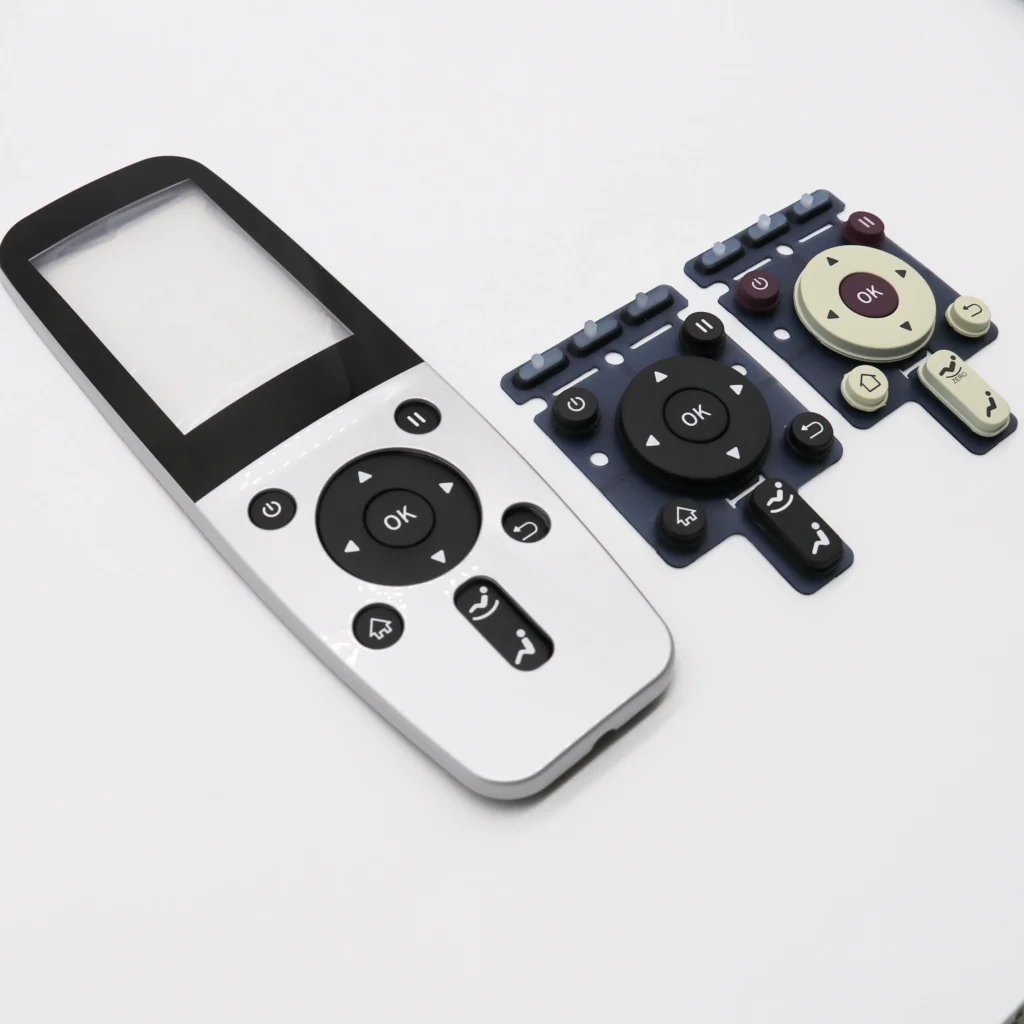
How to choose for your application:
Work from the environment and the operator backwards. Environment rules out one technology quickly, operator behavior rules out the other, and cost only decides when both survive the first two filters.
| Your priority | Better fit | Why |
|---|---|---|
| Operators wear gloves. | Silicone | Travel and snap are readable through glove material |
| The panel must be under 2 mm. | Membrane | Silicone needs 1.5–4.0 mm before the bezel |
| Frequent disinfectant cleaning | Silicone | Resists alcohols and quaternary compounds |
| Photographic quality graphics | Membrane | Digital printing on polyester overlay |
| Outdoor or unheated enclosure | Silicone | -50°C to 200°C, plus UV and ozone resistance |
| Short run under 1,000 units | Membrane | Tooling cost cannot be amortized. |
| Above 1 million actuations | Silicone | Wider fatigue margin |
| Tight unit-cost target | Membrane | Lower tooling and lower piece price |
| Blind operation required | Silicone | Three-dimensional keys and longer travel |
Choose a silicone keypad when
- Operators work in gloves or keep their eyes on the task.
- The panel is cleaned with disinfectants, solvents, or degreasers.
- The product lives outdoors, in a vehicle, or in an unheated enclosure.
- Expected actuations run past a million.
- Keys need sculpted shapes, varied heights, or raised characters.
Choose a membrane switch when
- Thickness is the binding constraint.
- Graphics carry branding, fine text, or display windows.
- Volume is low, and the tooling budget is limited.
- A flexible tail should plug straight into a board connector.
- Uniform backlighting matters more than key feel.
When a hybrid build makes sense
A silicone over membrane puts both technologies in one stack. The membrane layer carries the graphics, the circuit, and the tail. The silicone layer sits on top and supplies the keys, the travel, and the seal. Test equipment, medical user interfaces, and premium audio products use this build when neither technology satisfies the brief alone. It costs more than either one, but it removes the compromise.
What to send a silicone keypad manufacturer
Send the environment, the force profile, and the volume together. A supplier cannot quote a keypad on a drawing alone, because web geometry, durometer, and contact type all depend on how the panel will actually be used.
| Specification | What to state |
|---|---|
| Outline and key count | Panel dimensions, key layout, mounting method |
| Durometer | Target Shore A, usually 40–70 |
| Force and travel | Peak force, contact force, snap ratio, travel distance |
| Contact type | Carbon pill, metal dome, or gold-plated contact |
| Environment | Temperature range, chemicals, UV exposure, target IP rating |
| Legends | Printed, laser-etched, molded, or backlit |
| Compliance | Biocompatibility, flammability, RoHS or REACH requirements |
| Volume | Annual quantity, expected service life in presses |
| Validation | Force-stroke curves, cycle testing, IP testing, chemical soak testing |
Ask for force-stroke curves on the first article rather than a pass/fail result. The curve tells you whether the keypad will feel right after a year of use, which a single force reading cannot.
Perguntas frequentes
Can a silicone keypad survive daily hospital disinfectants?
Silicone handles alcohols, quaternary ammonium compounds, and diluted bleach better than printed polyester, which is why it is common on patient monitors and infusion pumps. The limit is usually the legend coating rather than the rubber, so specify the disinfectant by name when requesting a quote. Where the panel contacts patients, ask the supplier for biocompatibility documentation on the specific grade.
Can I replace an existing membrane panel with a silicone keypad on the same board?
Often yes, but rarely as a drop-in. A silicone keypad press fits into a bezel and compresses against the board, so the enclosure needs a recess, and the contact pads need to be interdigitated rather than a simple split pad. The board outline and connector usually stay unchanged, but expect a housing revision and a new first-article round.
Does cold weather change how a silicone keypad feels?
It does. Silicone stiffens as temperature drops, so peak force rises and the snap becomes less distinct. The effect is small across the range most products see, but a keypad tuned at room temperature can feel noticeably heavier at -30°C. Specify the lowest operating temperature and ask for force data measured at that temperature, not just at 23°C.
-768x768.webp)