Tiny silicone valves sit inside dispensers, medical devices, and household appliances, quietly controlling every drop and puff of fluid or air. When the valve is wrong, the result is drips, dosing errors, or backflow that spoils a sealed product. A custom silicone valve manufacturer can tune geometry and material to your exact conditions, yet you still need a clear picture of what to specify before you brief a supplier.
The right silicone valve is the one whose geometry, material grade, and opening pressure match the medium, flow, and regulatory demands of your product, so it dispenses cleanly, seals reliably, and survives mass production without leaking or sticking.
The steps below take you from defining your operating conditions to comparing valve shapes and choosing a supplier you can trust.
What a silicone valve actually does
A silicone valve is a one-way elastomeric part that opens under forward pressure and closes on its own to block reverse flow, which is why it is often called a silicone one-way valve or check valve.
Silicone suits this job because it stays flexible across a wide temperature range, resists many chemicals, and returns to shape after long compression. The valve has no spring and no metal seat. It relies on the elasticity of the silicone itself. That makes it quiet, light, and cheap to mold in high volume, which is why it shows up in everything from a coffee machine to a drug delivery kit.
How a one-way silicone valve opens and reseals
Under forward pressure the thin wall, lip, or slit deflects and lets media pass. When pressure drops or reverses, the part springs back, and the surfaces meet to form a seal. The forward pressure at which the valve first opens is called the cracking pressure. Lower cracking pressure means the product works with weak pumps or gravity feed. Higher cracking pressure resists backflow in pressurized lines. Reseal quality depends on compression set, the amount of deformation the silicone fails to recover after being held closed for a long time. This self-resealing behavior is why silicone valves work in battery-free and passively driven products where a spring or motor would add cost and failure points.
Define the working conditions in your product
List the exact fluid or gas, the flow rate and pressure range, the temperature, and any sterilization step before comparing valve shapes, because those conditions decide which geometry and material will actually work.
Fluid and gas compatibility
The first question is what passes through the valve. Water, oil, solvent, acid, flavor, or a gas each attacks silicone differently. Food and personal care media need taste-neutral, non-extracting silicone. Medical fluids need biocompatible grades. Cleaning agents and additives in the line are as important as the main product, because a valve that resists the formula but swells during the daily rinse will still fail in the field. Taste and odor neutrality also matters for premium drinks and cosmetics, where a valve that picks up or gives off smells ruins the product even if it seals perfectly.
Flow rate, pressure, and cracking pressure
Flow rate sets how open the valve must be at a given pressure. Cracking pressure sets when it starts. If cracking pressure is too low, the valve may weep under backpressure; if too high, the system strains to start flow. Match the valve to your pump curve or gravity head. Note the pressure drop across the valve at target flow and the backpressure it must seal against when closed. These numbers let a supplier choose wall thickness and hardness instead of guessing based on a shape name.
Temperature and sterilization exposure
Working temperature shapes material choice. Standard silicone serves roughly from -40 to 200 degrees Celsius, but sustained heat, steam, or cold changes hardness and life. If the device is sterilized, state the method: autoclave, gamma, or EtO. Each method affects which silicone grade and which cure system can survive repeated cycles. A valve qualified only for room-temperature use will harden or leak after a sterilization step it was never designed for. Write the sterilize-and-reuse count into the spec, because a valve that passes one cycle may drift after twenty and fail between the bench and the ward.
Match the valve geometry to your application
The three shapes you will meet most often are the silicone umbrella valve, the silicone cross slit valve, and the silicone duckbill check valve, and each fits a different balance of opening pressure, flow, and sealing.
Silicone umbrella valve
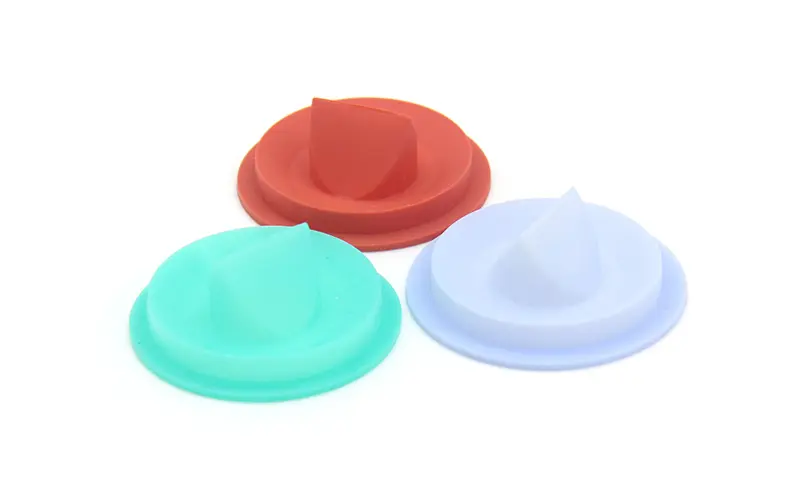
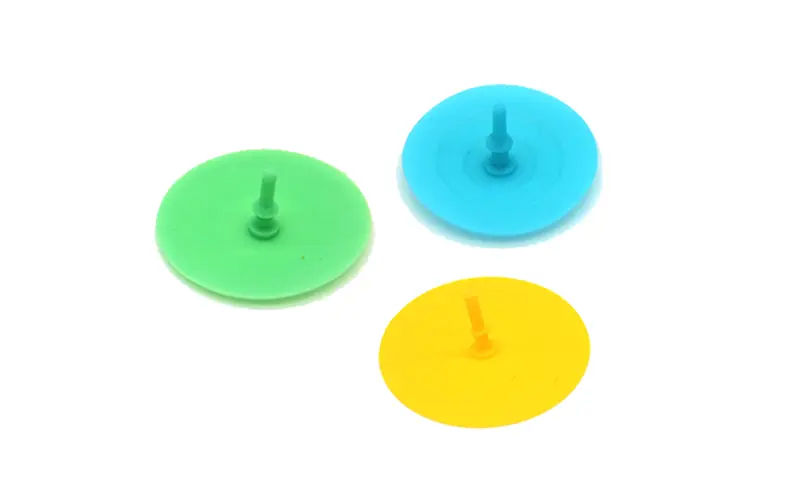
A silicone umbrella valve has a stem and a disc that looks like a small umbrella or mushroom. Pressure from below lifts the disc off its seat to flow; reverse pressure presses it back to seal. It handles both venting and check functions and reacts at low pressure, which suits respiratory circuits, dispenser caps, and pressure relief. Because the seal is a broad face, it reseals well after a long rest and resists particle catch in the gap.
Silicone cross-slit valve
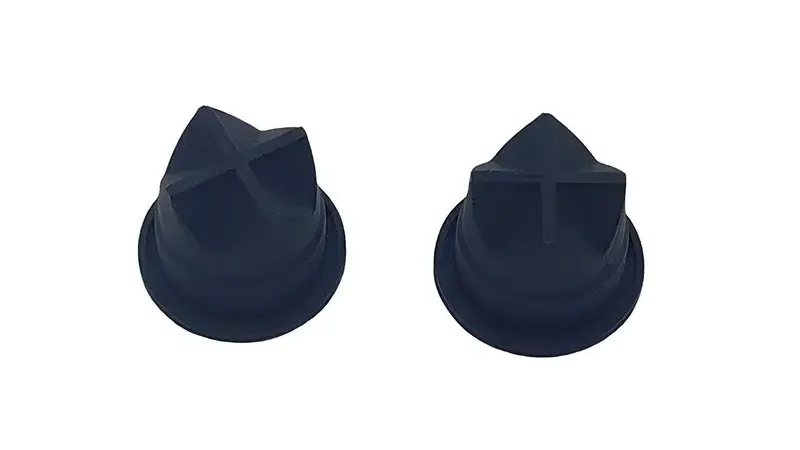
A silicone cross-slit valve is a flat membrane cut with a cross or X slit. Pressure pushes the slit open for a controlled stream; it snaps shut when pressure drops. It gives clean, drip-free dosing for sauces, lotions, and beverages, and it self-seals after many cycles if the slit is cut cleanly and centered. The cut angle and slit length set the flow and the leak point, so slit quality drives performance more than the rubber alone. For thick products, a slightly longer slit keeps the opening force low while still metering the dose, which is why the same part family covers both thin serums and thick pastes.
Silicone duckbill check valve
A silicone duckbill check valve tapers to a bill that parts under forward flow and collapses flat to seal against backflow. It needs very low opening pressure, carries high flow for its size, and has almost no dead volume, which helps hygiene in medical and infant products. It is position independent, so it works however it is mounted. Fluorosilicone versions resist fuel and oil, where standard silicone would swell, which extends the same shape into automotive and appliance lines. Its flat-collapsed seal also leaves almost no residue behind, a point that matters when the media is costly or must stay sterile between uses.
Compare the main valve types side by side
A side-by-side table lets you match opening pressure, flow behavior, and best-use case to your product so you can rule out shapes that cannot meet your spec.
| Valve type | Typical opening pressure | Flow behavior | Best fit |
| Silicone umbrella valve | Low to medium | Broad, vent and seal | Respiratory, relief, cap vents |
| Silicone cross-slit valve | Low | Precise drip, self-seal | Food, personal care dosing |
| Silicone duckbill check valve | Very low | High flow, low dead volume | Medical, infant, appliances |
A dome valve is a softer variant of the umbrella idea, used where a round seal face fits the housing. The table above covers the three shapes most buyers actually choose between.
Why slit and lip design changes flow control
Within one shape, the detail decides the feel. A wider slit or thinner lip opens sooner and flows more but seals less hard. A tighter slit holds back higher backpressure yet needs more pressure to start. Wall thickness and hardness shift the same curve in the same direction. That is why two cross-slit valves from different molds can dispense nothing alike. Ask the supplier for the flow curve at your pressure, not just a shape name, before you commit tooling. Document the allowed tolerance on these features so a tooling change later does not silently shift the dispensing feel your customers already accepted.
Pick the right material grade and hardness
Material grade sets what your valve may legally touch and how long it lasts, so food and medical products need certified silicone, while hardness and compression sets decide how well it reseals.
Food-grade versus medical-grade silicone
Food-grade liquid silicone rubber meets rules such as FDA and LFGB for contact with food and drink, with low extractables and no odor transfer. Medical-grade silicone adds biocompatibility testing such as ISO 10993 and is chosen for devices that touch the body or drugs. Platinum-cured grades give higher purity than peroxide-cured ones. The U.S. Food and Drug Administration publishes guidance on food contact substances that sets which materials may safely touch food. Pick the grade by where the valve sits in the product, not by habit.
Hardness, compression set, and wall thickness
Hardness in Shore A trade-off against pressure. Softer silicone cracks open at lower pressure but deforms more; harder silicone holds shape under higher load yet needs more force to open. Compression set, the share of deformation not recovered, decides reseal after long closure. Wall thickness and tolerance hold the cracking pressure steady from part to part. Tight wall control, often within a fraction of a millimeter, is what keeps a batch of valves behaving the same instead of drifting across a production run. Ask for the lot-to-lot range, not a single best-case number, since the worst part in the box is what your customer actually meets on the shelf.
Check manufacturing quality before you commit
Good molding and slit cutting turn a correct design into a valve that seals every time, so you should check the process and the test results, not just the drawing.
Molding method and flash control
Liquid silicone rubber injection molding gives consistent shapes and smooth surfaces when tooling and process are controlled. Compression molding suits some larger parts. Flash, the thin excess at the parting line, must be removed cleanly, because a ragged edge leaks and catches. Automated deflashing beats hand trimming for repeatability. Ask how the supplier controls flash and what the surface finish spec is, because the seal lives at that edge. A clean edge also reads as right to the user, since a ragged valve looks cheap even when it still functions.
Slit precision and leak testing
For slit valves, the cut is the working core. Automated, centered cutting gives a complete slit with a controlled angle and no sticking; hand or misaligned cuts leak or dispense unevenly. Leak testing, often inverted and under backpressure, confirms sealing lot to lot. Request the slit tolerance, the cut method, and the leak-test rate. A supplier that cannot show these numbers is guessing where your seal comes from.
Work with a capable silicone valve manufacturer
A supplier that joins your design early, builds real prototypes, and shares test data reduces the risk of leaks, recalls, and late redesigns far more than the lowest quotation.
Custom design, tooling, and prototyping
Early collaboration between your engineers and the molder pays off. Joint design reviews catch parting lines, gates, and venting that block micro-features like thin lips and fine slits. Prototype iterations prove the flow and seal before steel is cut. Tooling built for the real tolerance saves the cost of rework later. Treat the valve as a system with its seat and housing, not a loose part dropped into a hole. Small changes to the seat, not the valve, often fix a flow problem, so review the pair together rather than blaming the silicone when the line misbehaves.
Samples, documentation, and quality verification
Before you commit, ask for samples, a material data sheet, and lot test reports covering flow, leak, and hardness. For medical and food use, request the compliance certificates and traceability of the silicone lot. A capable silicone valve manufacturer keeps records that survive an audit and supports validation in your device. Documentation is part of the product, not paper added at the end after a problem appears. Good suppliers also help you plan validation so the valve evidence feeds straight into your own regulatory file instead of forcing a second round of testing.
Frequently asked questions
What is the difference between a duckbill valve and an umbrella valve?
A duckbill valve uses a tapered bill that parts under forward flow and flattens to seal, with very low opening pressure and little dead volume. An umbrella valve uses a disc on a stem that lifts off a seat, handling both venting and check duties with a broader seal face. Pick a duckbill for high-flow one-way medical or infant lines and an umbrella for relief and cap vents where a wide seal matters.
Can a silicone valve handle both liquid and air?
Yes. Silicone valves are used for liquids such as sauces, lotions, and reagents and for gases in respiratory and venting paths. The same geometry can serve both, but viscosity and pressure differ, so confirm the flow curve for your actual media rather than assuming a valve rated for air also meters a thick liquid without adjustment.
How do I verify that a silicone valve seals without leaking?
Run an inverted backpressure leak test on samples, hold the valve closed under the reverse pressure it will see in use, and check for seepage over a set time. Pair this procedure with lot records for hardness and slit dimensions. For critical products, validate after sterilization, because heat or radiation can change the seal across cycles and hide a leak that only appears later.