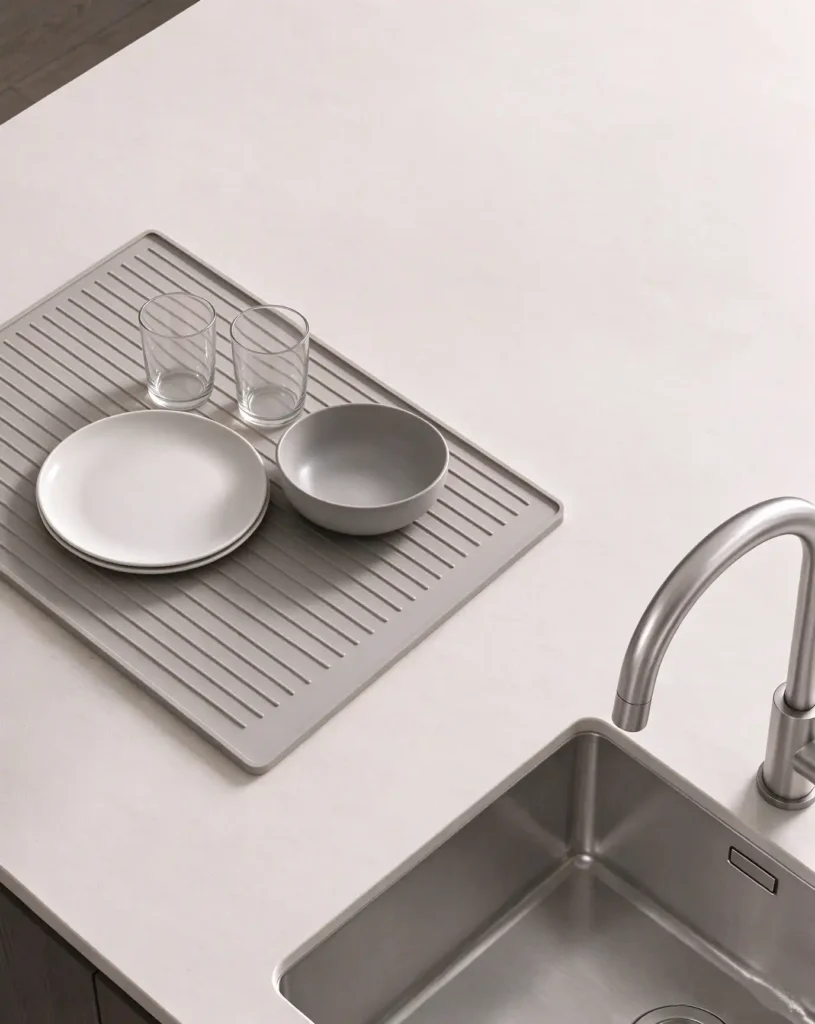
Silicone products have become increasingly popular in the kitchen because they address several practical pain points at once. Below we explain why food-grade silicone is the material of choice for kitchenware—and then walk through a real custom silicone drain mat project for a European home & lifestyle brand, showing how we solved three manufacturing challenges: compression-molding impurities, dust attraction, and bacterial growth.
Why Silicone Is Ideal for Kitchen Products
1. Food Safety for Direct Food Contact
Safety is a fundamental requirement for kitchen supplies. Food-grade silicone is BPA-free, odorless, non-toxic, and chemically stable. It won’t release harmful substances even under high heat or when exposed to oil—making it a safe, reliable choice for baking molds, spatulas, oil brushes, cake scrapers, and many other kitchen tools.
2. Temperature Resistance (Heat and Cold)
Silicone withstands temperatures from -40°C to 230°C, so it can go straight from the freezer to the oven. Unlike plastic, it won’t melt or deform. Unlike metal, it won’t burn or scratch your cookware.
3. Soft, Elastic, and Slip-Resistant
Silicone offers a soft texture and a secure, non-slip grip—properties used in oven mitts, anti-slip mats, and trivets. If dropped, it won’t shatter like ceramic or glass, nor damage countertops the way metal might.
4. Easy to Clean and Resistant to Bacterial Growth
Silicone has a smooth, non-porous surface that prevents oil and food residue from seeping in. It can generally be cleaned easily in a dishwasher or with hot water and dish soap. Unlike wooden cutting boards, it doesn’t absorb moisture—helping keep mold at bay.
Project Background: Custom Silicone Drain Mat
A European company specializing in functional home and lifestyle goods wanted to design a solid-color silicone drain mat for both sink and bathroom use. Requirements included:
Food-contact safety;
Effective drainage;
Heat resistance up to 299°C;
Non-slip surface;
Easy cleaning;
Clean, solid-color aesthetic without visible impurities.
Silicone was clearly the optimal material—but meeting all requirements in one product came with challenges.
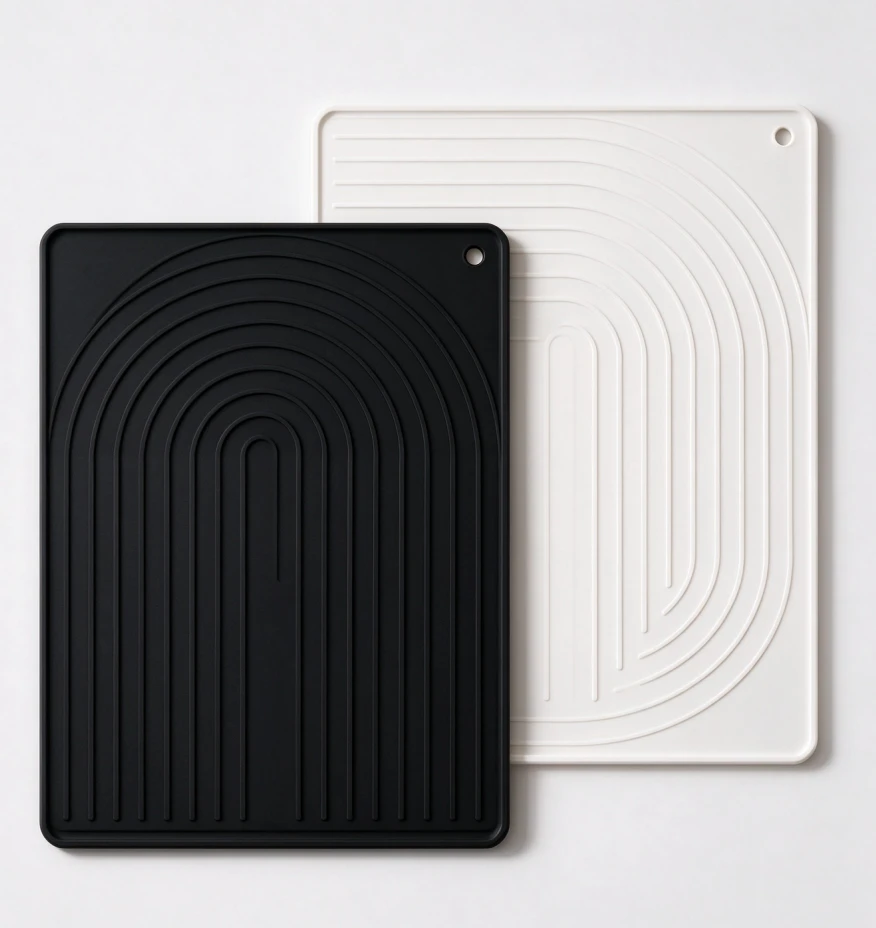
Challenge 1: No Gating + Cost-Effective = Compression Molding Impurities
Challenge: The customer did not permit gating on the product and preferred a cost-effective solution, so the mat could only be produced via compression molding. For a mat of this size in a light color like beige, impurities cannot be entirely avoided—and they are far more visible than in black.
Solution: LSR injection molding would easily meet the cosmetic requirement, but it requires gating, which the customer rejected. That left compression molding, which involves open processes (mixing, cutting, weighing) and manual material setting—raising contamination risk. We considered an automatic feeding machine, but the mat requires about 1 kg of material—too heavy for the feeder. The final solution was a hybrid approach: the machine handles cutting and weighing, while the operator transfers material from the feeder into the tool cavity. This reduced manual operation and exposure time, lowering impurity risk while retaining necessary flexibility.
Challenge 2: Dust Attraction Due to Electrostatic Adsorption
Challenge: Silicone attracts dust easily. Typically, a matte or eroded tool finish or a PU coating on the product helps—but tooling finish alone wasn’t enough for this mat. The customer was open to a food-grade PU coating if it was long-lasting.
Solution: We were concerned about PU coating durability and safety—the coating layer may come off after prolonged abrasion, and detached particles could mix into food or water, which is prohibited. Instead, we recommended UV treatment: a dry process that chemically modifies the silicone surface using ultraviolet irradiation. No solvents or coatings are added, no detached substances are produced, and it is environmentally friendly and fully food-contact compliant. Because the protection comes from modifying the silicone rubber itself, the dust-proof effect is long-lasting.
Challenge 3: Wet Surface = Bacterial Growth
Challenge: The drain mat is designed to catch dripping water, so its surface remains almost constantly wet—a critical factor in bacterial growth. Silicone itself is chemically inert and neither bactericidal nor bacteriostatic, so bacteria can proliferate, causing off-odors or mold that may transfer to tableware.
Solution: Drying is the most effective way to prevent bacterial growth, but keeping the mat dry during daily use is impossible. We used an antibacterial agent that destroys bacterial cell membranes and interferes with metabolism and DNA replication, achieving broad-spectrum antibacterial activity at the source. The additive is compatible with silicone molding temperatures, heat-resistant, and food-contact compliant—ensuring both processability and safety.
Result: A Market-Ready Silicone Drain Mat
This case study shows how tailored silicone manufacturing solutions transformed a challenging drain mat project into a highly marketable product. Our solutions met all technical and safety standards and delivered a superior, long-lasting antibacterial silicone drain mat with strong consumer appeal—reliable, safe, and clean-looking, positioned for strong sales in both kitchen and bathroom applications.