Outdoor products meet water as driving rain, a washdown hose, a puddle at the base of a housing, full submersion and steam. All of them load the same few interfaces, and a leak rarely appears as an obvious fault on the line. It surfaces months later as a warranty claim.
A silicone seal is the usual answer for wet and outdoor service, because a cured silicone network keeps its elasticity across a wide temperature range and is not attacked by ultraviolet light or ozone the way unsaturated rubbers are. Whether the assembly stays dry is decided by four design choices rather than the compound name: which water exposure the part must survive, how hard it is, how much it is compressed, and how that compression is held over thousands of cycles.
That sequence, from exposure to retention, is how a fabricante de vedantes de silicone works through a wet-service part.
Is Silicone Sealant Good for Outdoor Use?
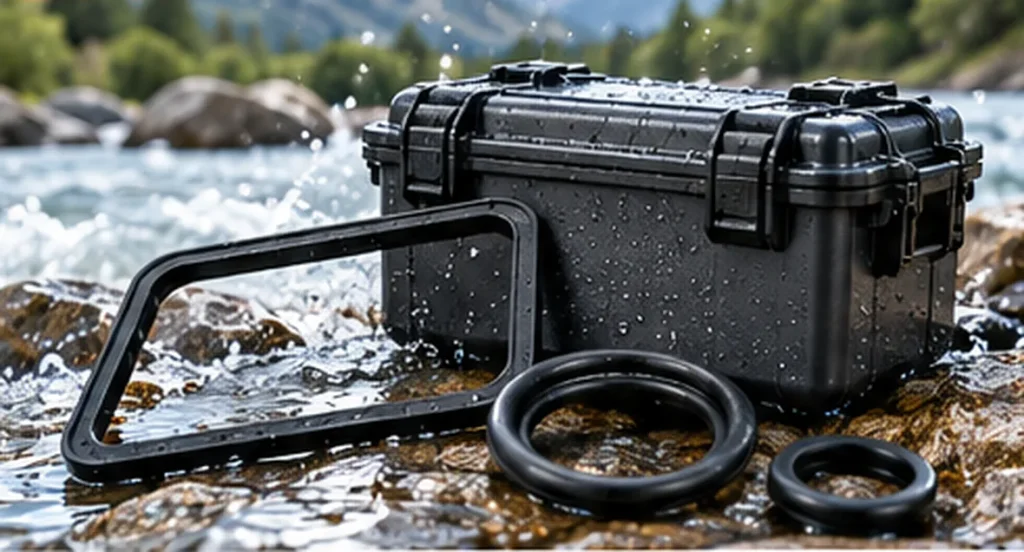
Yes, against the outdoor stressors themselves. A cured silicone seal resists ultraviolet radiation, ozone and temperature extremes better than most general-purpose elastomers, and it does not embrittle after a season in the sun. The qualification is that outdoor performance is a property of the joint rather than the material, so a good compound in a badly designed groove still leaks.
The material reason sits in the siloxane backbone. A silicon to oxygen bond takes more energy to break than the carbon to carbon bond that dominates organic rubbers, which is why borracha de silicone holds its properties across a wider temperature span and springs back after compression instead of staying flattened. The same backbone does not absorb ultraviolet radiation strongly in the band reaching the ground, and it has no unsaturated sites for ozone to attack.
Applied Sealant or Pre-Formed Silicone Seal?
Two products sit behind the same search term. A sealant joint formed in place is dispensed as a paste and cures inside the joint, sealing by adhering to both faces and filling the gap. Its performance depends on how clean those faces were, and the joint cannot be compressed twice. A pre-formed silicone seal or gasket is molded to size before assembly and seals by being squeezed a known percentage between two surfaces, so groove depth, squeeze and retention carry the result, not adhesion. Everything below on squeeze, groove design and retention refers to that second category.

What to Look for in an Outdoor Silicone Sealant
For the paste version, the cure system matters more than the label. Acetoxy systems release acetic acid as they cure, harmless on glass and ceramics but able to attack some metals in a closed joint, so neutral alkoxy and oxime grades are usual against metal and concrete. Then check the modulus, adhesion to the real substrate rather than a coupon, and whether the datasheet permits the intended water exposure.
Is 100% Silicone Sealant Waterproof?
A cured 100% silicone product is waterproof in the everyday sense: it does not dissolve, swells very little, and keeps water out of a properly closed joint. That is not the same as being rated for permanent immersion. Not every 100% silicone sealant is rated for continuous immersion or pressurized water exposure, and a datasheet listing weather resistance may say nothing about a part below the waterline.
Two properties get merged in that claim. Water absorption describes how much liquid the cured material takes up, and for silicone it is low enough that dimensional change is not a design concern. Water vapour transmission is different: silicone is permeable to water vapour, which suits assemblies that must let condensation escape. A low absorption figure therefore says nothing about vapour.
For continuous immersion, four other factors take over: compression set decides whether the part still pushes back after a year, hydrolysis behaviour decides how it copes with hot water, adhesion loss decides whether a dry interface stays dry at month twelve, and hydrostatic pressure decides how much force is trying to lift the seal.
Waterproof, Water-Resistant and Watertight
The three words are used interchangeably in marketing and mean three different things in a specification. Water-resistant describes a product that survives rain and splashing, with no claim about immersion. Waterproof is a claim with no single test method behind it, so ask which standard and level the supplier tested to. Watertight, or a stated ingress protection level, is a measured result from a defined test on a complete enclosure, and only that can be audited.
Where a Bead of Sealant Stops Being Enough
Four conditions push a project from a bead to a molded part. The assembly has to be opened for service, which destroys a cured joint every time. There is no mechanical retention, so the joint depends entirely on adhesion. The joint moves with temperature or load. Or water stands on the joint. Salt water and chlorinated water belong in the same group, because they add a chemical load on top of the mechanical one.
Matching a Silicone Seal to the Water Exposure Regime
Start with the water exposure, and only then set hardness, compression and retention. Choosing a hardness first and hoping the assembly stays dry inverts the logic, and it is the most common reason a well made part leaks in service.
Five Water Exposure Regimes
Most outdoor and wet-service parts fall into one of five regimes, and the regime sets the seal solution worth prioritising.
| Regime | Typical Service Conditions | Seal Solution to Prioritise | Design Check |
| Rain and wind-driven spray | Intermittent, with sun and daily cycling | A weather-resistant sealant or a compression gasket | A continuous path with no open ends |
| Splash and washdown | Jets, hoses and cleaning chemicals | A seal ring or gasket retained mechanically | Retention against jet pressure |
| Intermittent immersion | Puddles, wave wash and dunking, then drainage | A seal configuration verified by immersion testing | Drain paths so water cannot stand |
| Continuous immersion or pressure | Permanently submerged, or head pressure | Verified for pressure, duration and material compatibility | Compression set; groove and squeeze |
| Steam and hot water | Kettles, sterilising, hot washdown | Verified for hot water and steam | Temperature rating of seal and housing |
Hardness, tolerance and compression set targets for the same part are set out in the Guia de especificações de vedantes de silicone.
Holding a Seal Against Water Pressure
Water pressure needs somewhere to push, so the answer is a force balance rather than a material choice. Hydrostatic pressure rises with depth and acts on the exposed face of the seal, so a joint designed for splash has no reserve once a housing sits in a puddle. What holds the seal is clamping force from the hardware, and that force has to survive vibration, thermal expansion and fastener corrosion. A groove keeps the seal from rolling on the unsupported low pressure side.
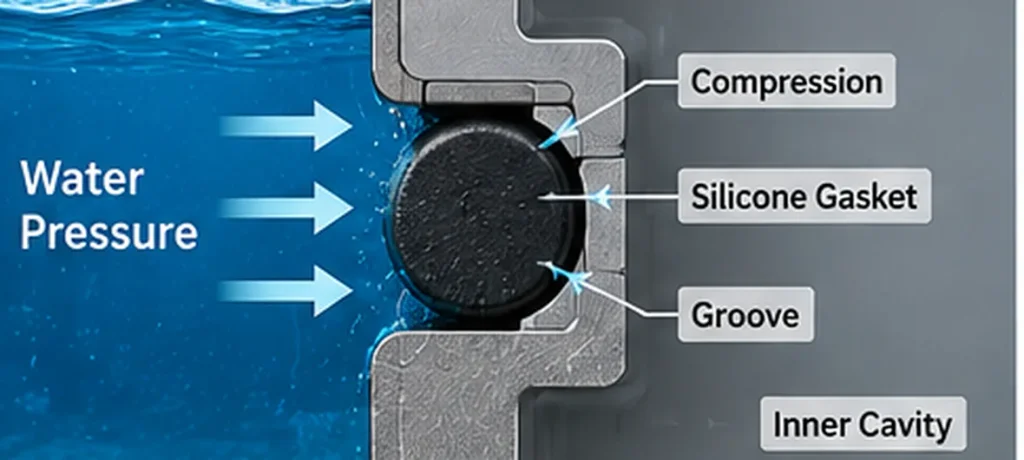
Trapped air is the factor most often missed: a sealed housing warmed by the sun expands its internal air far more than the seal can accommodate, pushing outward against the seal that keeps water out. Vents and breathable membranes exist for exactly that reason.
Salt, Chlorine and Hard Water
Salt spray leaves crystals in crevices, and crystal growth can wedge a seal off its land. Chlorinated water at ambient pool concentration is generally tolerated by silicone, but free chlorine combined with elevated temperature is the case to validate. Hard water deposits scale under the seal lip, and a thin scale layer lifts the seal by exactly the amount needed to start wicking. In all three cases the elastomer is often still sound when the assembly starts to leak.
Outdoor Stresses That Are Not Water
Outdoor seal performance depends on combined exposure to sunlight, temperature cycling, moisture, contaminants, and mechanical stress. No single factor dominates, because they act on the same interface at once. A sun-exposed enclosure ages mainly through heat and daily cycling, a submerged part mainly through prolonged compression and water chemistry at temperature.
Material limits for water, temperature and chemistry are collected under silicone resistance.
Sun, Ozone and Temperature Cycling
Ultraviolet light changes the surface of silicone more than the bulk. Chalking and a modest surface hardening are typical, so the part looks like it has failed when a chalked surface is only holding dirt and a water film. Daily temperature cycling is the more structural factor: a housing that swings thirty to fifty degrees Celsius between night and afternoon moves its seal every day, and a season of that becomes thousands of small compressions.
Freeze-Thaw and Trapped Water
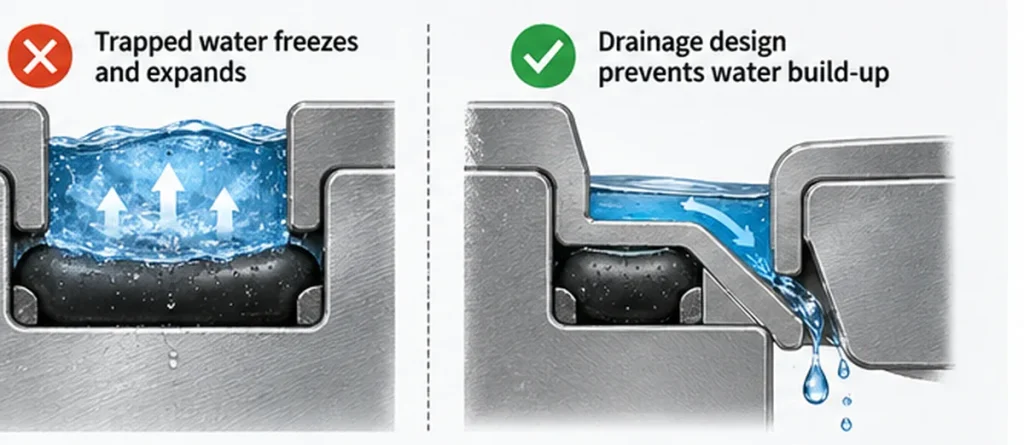
Where water can stand in a groove, behind a fastener or along a joint lip, a cold night turns it into expanding ice. The force released by that phase change can deform a housing or break a seal interface away from its substrate. This is damage caused by trapped water, not by silicone becoming brittle, and the remedy is rarely a different compound: a drain hole, a slope, a chamfer or a repositioned joint line stops the water collecting.
Sand, Mud, Dust and Microbial Growth
Abrasive particles packed into a sealing groove wear the seal surface and can hold it open. Fine dust and dried mud also wick water into a crevice, which is how a joint that looks clean outside stays wet inside. Shaded damp joints are the usual site for mould and algae, an appearance problem rather than a seal failure.
Sealing Points Across Outdoor Gear
Most outdoor gear leaks at a handful of predictable interfaces rather than at random. Naming the interface first makes the seal choice straightforward, because it already tells you whether the seal will be compressed once or resealed many times, and whether water will drain off it or stand on it.
| Gear or Assembly | Typical Seal Format | What Decides Success |
| Outdoor enclosures, junction boxes and control housings | Cord or molded gasket in a groove | Protection verified on the complete enclosure |
| Portable speakers, headlamps and handheld electronics | Molded gasket or overmolded seal | Drop and vibration retention |
| Coolers, dry bags and watertight cases | Flat gasket or molded lip seal | Uniform clamping force |
| Bottles, hydration systems and drinkware | Small molded ring or a valve seal | Repeated open and close cycles |
| E-bike, scooter and power equipment housings | Molded gasket under fastener clamping | Temperature cycling and vibration |
| Garden, washdown and irrigation equipment | Ring seal with mechanical retention | Jet pressure and cleaner compatibility |
| Marine and watersports hardware | Molded gasket, corrosion-resistant hardware | Salt exposure and fastener corrosion |
| Solar and outdoor lighting hardware | Molded gasket with a vent path | Heat build-up and pressure equalisation |
Serviceable Sealing Instead of a Permanent Bead
Once an assembly has to be reopened, a molded part outperforms a bead, because a sealant joint is destroyed on disassembly and cannot be rebuilt to the same standard in the field. Within molded parts, cord in a groove locates itself and tolerates more squeeze, while a flat gasket depends on a controlled land width and a flat face. The formats and their installation practice are compared in silicone seal strips gaskets and o-rings.
Failure Modes and Verification
Water ingress usually originates in the joint, the hardware or the assembly process rather than in the silicone, so diagnosis starts by identifying which of those three moved.
Six Failure Modes and Their Fixes
| Symptom | Likely Cause | Design or Process Fix |
| Leak on first assembly | Seal cut, twisted or pinched during fitting | Groove lead-ins; retain the seal during assembly |
| Leak after weeks of immersion | Compression set: the part stops pushing back | Lower compression set compound; recheck squeeze |
| Water travels along a seam | Capillary path between two wetted surfaces | Continuous gasket path; remove the crevice |
| Leak at one corner or low point | Water standing on the joint | Add a weep hole, slope or chamfer |
| Damage after a cold night | Trapped water freezing in a groove | Remove the water trap; avoid blind pockets |
| Leak returns after field service | Fasteners relaxed; seal not seated | Torque specification; a self-locating seal |
Compression set is the mechanism behind the second row and it is measurable: the test method for compression set of vulcanised and thermoplastic rubbers is defined in ISO 815-1, which separates a short classification test from the longer ageing test used to predict sealing performance.
Testing Ingress Before Volume Release
Ingress protection levels are not interchangeable, and the difference is what the test does to the sample. A splash rating covers water sprayed at the enclosure from an angle, a jet rating a directed stream at a stated pressure and distance, a temporary immersion rating a defined depth and short duration, and a continuous immersion rating the depth, duration and temperature the manufacturer states. The framework behind those levels is published in IEC 60529. One point is worth repeating: the level applies to the whole enclosure, never to a bare silicone part.
The order of tests decides whether the result means anything. A fresh assembly can pass a water test and still fail in the field, because temperature cycling has not yet moved the seal in its groove. Running thermal cycling and an assembly repeatability check first, then the corresponding water test, answers the question the customer is asking, and the sequence should follow the risk of the product. Verification should run on production substrates with a traceable compound lot, both of which a fabricante de peças de silicone de precisão builds into the first article loop.
Perguntas frequentes
Will silicone cure in a wet environment?
A moisture-curing sealant needs water vapour from the air, not liquid water, so high humidity shortens the skin time rather than hindering the cure. Immersion is different: water lying on the bead interferes with adhesion development, so a joint that is fully underwater may never reach the bond it would have in air. A molded silicone part is already cured when it is packed, so the question does not apply to a gasket or an O-ring.
Does silicone sealant work below the waterline?
Only if the product is explicitly rated for immersion and the joint is mechanically supported. Water pressure rises with depth and pushes an unsupported bead off its land, and a joint designed for splash has no reserve for that load. For a permanently submerged interface the practical answer is a pre-formed gasket compressed in a groove, with clamping force from corrosion-protected fasteners. A bead below the waterline is a secondary barrier at best.
How much of an outdoor seal’s life is decided by the compound versus the joint design?
Most of it is decided by the joint. Two comparable compounds in the same groove differ far less than one compound in a good groove and a bad one. The compound sets the ceiling, meaning the temperature range, chemical resistance and compression set it can hold, while the joint decides whether that ceiling is reached. A specification that names a grade but leaves squeeze, retention and drainage open has settled the smaller half of the problem.